
Cottonwood Heights UT Permanent Christmas Lights

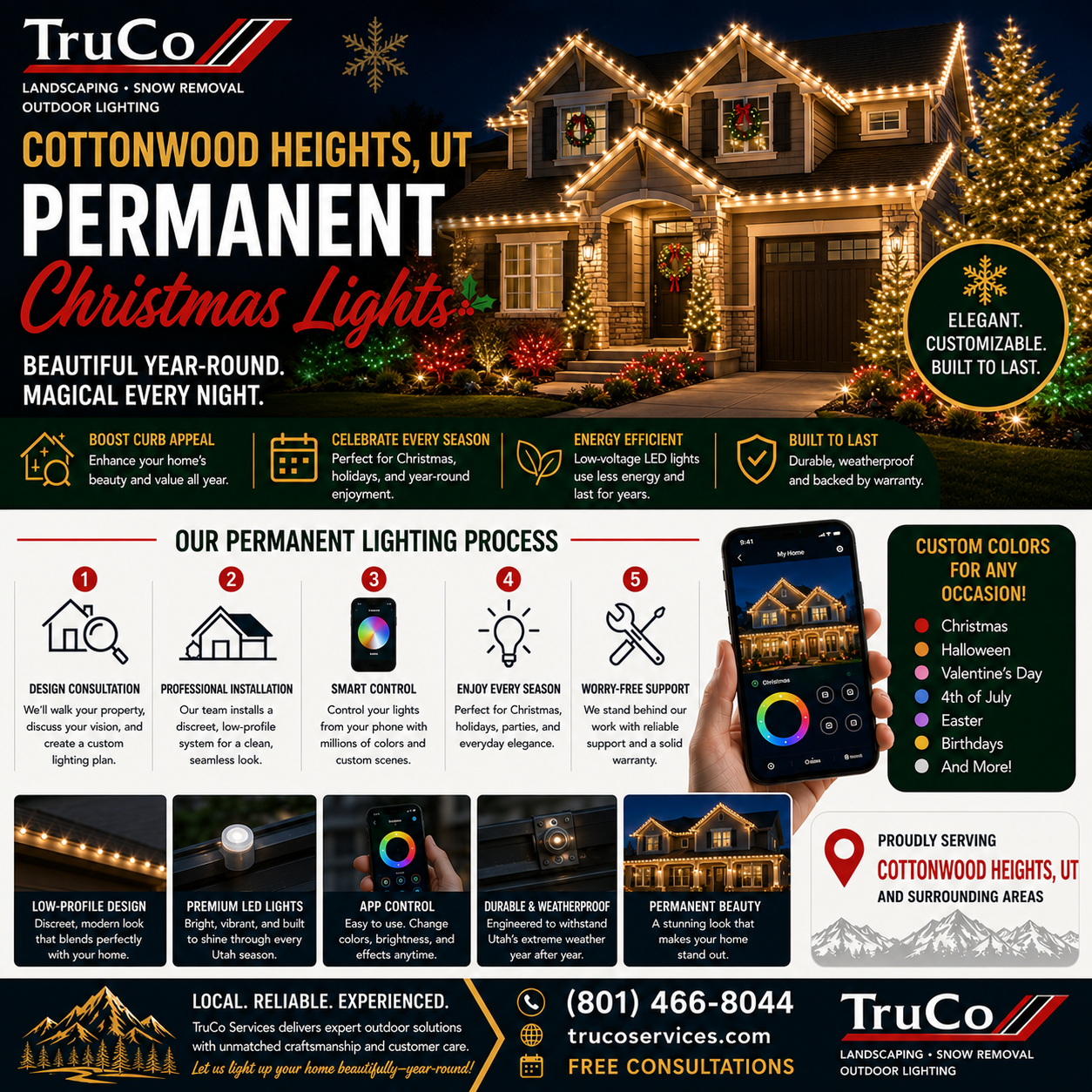
Cottonwood Heights UT permanent Christmas lights are exterior LED lighting systems installed to remain on your home throughout the year. They let homeowners use app-controlled colors, schedules, brightness settings, and lighting patterns for Christmas, Halloween, birthdays, sporting events, patriotic holidays, parties, and warm-white architectural accent lighting—without the annual work of climbing ladders, hanging temporary strings, untangling cords, and storing lights after the holidays.
The most important takeaway is that permanent holiday lighting is a long-term exterior improvement, not simply seasonal décor. The finished result depends on much more than choosing colorful LEDs. Your roofline design, track color, wire routing, mounting method, weather resistance, power source, controller location, service plan, warranty terms, and future roof or gutter work all matter. A rushed or low-priced installation can lead to visible hardware, uneven lights, water-related failures, electrical concerns, expensive repairs, or premature removal.
This guide helps Cottonwood Heights homeowners understand how permanent lighting works, what to compare, the problems to prevent, local code considerations, available options, and how Truco Services can help create a system that looks intentional and remains useful long after the first holiday season.
What Are Cottonwood Heights UT Permanent Christmas Lights?
Permanent Christmas lights are low-profile LED fixtures installed along a home’s architectural lines. Common installation locations include soffits, fascia boards, rooflines, garage edges, front gables, dormers, porches, patios, and entryways.
The lights remain physically mounted to the exterior, but homeowners choose when and how to use them. The system may be turned off for long periods, programmed to run warm white at low brightness, or set to holiday colors and animated displays for special occasions.
Most permanent exterior holiday lighting systems use individually addressable LED modules, sometimes called “pucks.” This means single lights—or small groups of lights—can display different colors at the same time. That flexibility allows a homeowner to create red and green for Christmas, purple and orange for Halloween, patriotic color combinations, school colors, or a subtle warm-white roofline setting.
A typical permanent lighting installation includes:
LED modules or puck lights
A track or channel that holds lights in consistent positions
Outdoor-rated cable, wire, connectors, and fasteners
A controller that manages patterns, zones, brightness, colors, and schedules
A power supply or suitable electrical connection
App, Wi-Fi, Bluetooth, remote, or local-control features
Professional installation, testing, programming, and homeowner instruction
For example, a Cottonwood Heights homeowner might use a warm-white scene most evenings, create a red-and-green Christmas display in December, use orange and purple in October, and schedule the lights to turn off automatically before late-night hours.
How the Installation Process Works
The process typically begins with an exterior evaluation and design discussion. The provider measures the visible rooflines, examines soffits and fascia, identifies likely controller and power locations, considers installation access, and discusses which features you want to emphasize.
After approval, the installer mounts the track or fixtures, routes wiring carefully, connects power and controls, tests every run, and helps set up the system. A complete job should include a walkthrough of the app, brightness settings, schedules, presets, zone controls, and basic troubleshooting.
Cottonwood Heights states that it enforces the 2021 International Residential Code, 2021 International Building Code, and 2020 National Electrical Code, with applicable state amendments. The city directs residents with code questions to call the Building Department at 801-944-7060.
Whether a permanent lighting project requires a permit depends on its electrical scope. A plug-in system using an appropriate existing outlet may differ from a project involving new wiring, new exterior outlets, dedicated circuits, hardwired equipment, or electrical alterations. Confirm the requirements for your individual project before work begins.
9 Things to Know Before Installing Permanent Lights
1. Your Lighting Design Should Fit the Home
The best permanent Christmas lights in Cottonwood Heights are designed around the home’s architecture. They should emphasize the property’s strongest visual lines without making the exterior look crowded, overly bright, or unbalanced.
Every home is different. A single-story home with a broad front roofline may look excellent with simple roofline and garage illumination. A two-story home with multiple front-facing gables, dormers, and large garage sections may need more detailed planning. Homes near the Wasatch foothills may also be visible from a greater distance or sit on lots where elevation changes affect how the lighting appears from the street.
Begin by viewing your home from the public street. Identify the rooflines, garage edges, front porch, gables, dormers, and entry features that define its shape. These are normally the areas worth considering first.
For example, a large front-facing gable often looks best when both slopes are outlined. Lighting only one side can look accidental. However, lighting every small roof return can make the home appear cluttered and drive up the total cost without adding much curb appeal.
A thoughtful design considers:
Primary viewing angles from the street
Roofline height, complexity, and visibility
Soffit depth and fascia condition
Trees, landscaping, and lot elevation
Nearby homes and possible glare
Desired use beyond Christmas
Budget and possible future expansion
Ask for a written scope or layout before approving the project. Confirm exactly which rooflines are included, whether the estimate includes upper peaks, garage lines, patio covers, track color, controller placement, wire concealment, app setup, and any future service expectations.
2. The System Is Only as Good as Its Components
Permanent holiday lighting is not just a row of LEDs. It is a complete exterior system made up of light modules, tracks, wiring, connectors, controllers, power supplies, fasteners, and weather protection.
A premium-looking LED display can still fail if the cable is poor quality, tracks are not mounted correctly, connectors allow moisture in, the controller is placed in a vulnerable area, or the power equipment is not sized for the installation.
Quality components should be designed for permanent outdoor exposure. Cottonwood Heights homeowners should consider intense sunlight, winter snow, rain, temperature swings, wind, and possible ice buildup when comparing systems.
The track is especially important. A color-matched track can help the lights blend into the soffit or fascia when turned off. It also keeps lights evenly spaced and can protect wire from view. By contrast, exposed cable, inconsistent spacing, mismatched track, or loose connectors can make the installation look temporary even if the lights work.
Ask potential providers:
What brand and model of system is proposed?
Is it intended for permanent outdoor installation?
Is the track color matched to my soffits or fascia?
How are connectors and wiring protected from moisture?
Can individual lights or sections be repaired?
Will replacement parts be available in the future?
How are power supplies and controllers protected?
What is included in setup and future support?
Avoid decisions based only on phrases such as “commercial-grade” or “high-end.” Ask for clear product details and plain-English explanations of how the system is built, installed, repaired, and supported.
3. Weather Resistance Depends on Installation Quality
Outdoor lighting must withstand more than one holiday season. Cottonwood Heights experiences strong sun, snow, rain, cold temperatures, wind, and seasonal expansion and contraction. Those conditions can expose installation shortcuts quickly.
UV exposure can fade or weaken inferior track material, plastic housings, and wire jackets. Freeze-thaw cycles can stress mounting points. Snow and wind can pull on loose tracks or unsupported wire. Water can reach unprotected connectors and cause intermittent problems that are difficult to diagnose.
A weather-conscious permanent lighting installation should include:
Secure tracks mounted with appropriate fasteners
Even mounting spacing along long rooflines
Wiring that is supported and not pulled too tightly
Exterior-rated connectors protected from direct moisture
Controller and power equipment located away from unnecessary water exposure
Clear routing around gutters, downspouts, vents, and drainage pathways
A mounting method appropriate to the specific exterior material
Reasonable access for future service or repair
Roof protection matters. Permanent lights should not compromise shingles, flashing, roof drainage, attic ventilation, gutters, or fascia. Most quality systems mount to soffits, fascia, trim, or dedicated tracks rather than through roofing materials.
Ask how the provider plans to handle peaks, corners, roofline changes, wiring transitions, and areas near gutters. The goal is not merely for the lights to look good at night. The goal is for the system to remain straight, secure, subtle in daylight, and dependable through changing seasons.
4. Electrical Planning Needs to Happen First
LED permanent lights generally use less electricity than older incandescent holiday strings, but they still require a safe and appropriate power plan. The system must have the right power source, weather-protected connections, suitable equipment, and an installation method consistent with code and manufacturer instructions.
A permanent system should not rely on exposed extension cords, overloaded outlets, temporary adapters, or improvised wire connections. These shortcuts can affect safety, reliability, future maintenance, and possible permitting requirements.
Cottonwood Heights enforces the 2020 National Electrical Code with state amendments, according to the city’s published code standards.
Before approving an installation, ask:
Where will the lighting system receive power?
Is the existing exterior outlet appropriate for the proposed equipment?
Will a dedicated circuit, new outlet, or hardwired connection be added?
Does the proposed connection require GFCI-related evaluation?
Who will perform any electrical modifications?
Who will determine whether permits or inspections are required?
How will the power supply, controller, and exterior connections be protected?
How will wiring be routed and concealed?
Cottonwood Heights provides a building-permit process that starts with determining whether a permit is needed, preparing plans when required, submitting an application, and obtaining inspections.
This guide is general information, not legal or electrical advice. Local requirements can depend on the equipment and exact scope of the project. Verify current requirements before work starts.
5. Daytime Appearance Matters as Much as Nighttime Effects
Nighttime color displays are what sell permanent Christmas lights, but the system remains visible during the day. That makes daytime appearance a critical part of the investment.
The best installations are noticeable when turned on and easy to overlook when turned off. This depends on a well-matched track, straight installation, even spacing, concealed cable, clean transitions, and discreet controller placement.
Look for these daylight standards:
Tracks that match or complement soffit and fascia colors
Straight, evenly aligned lighting runs
Consistent spacing between modules
Clean corners and roofline transitions
Wiring hidden or routed neatly
No dangling loops or unnecessary exposed connectors
Controllers and power supplies that are accessible but not highly visible
No interference with gutters, vents, downspouts, or exterior trim
Request daytime photographs of completed installations. Night photos show color and brightness, but daylight photos show workmanship. Examine whether tracks look straight, wires are hidden, colors blend with the home, and corners look clean.
Controller placement should be agreed upon in advance. A garage location may offer excellent weather protection but require a strong signal for app-controlled systems. An exterior location may be easy to service but needs proper protection and visual planning. Your provider should explain the chosen location before the system is installed.
Permanent lighting should complement your home throughout the year. If you would be unhappy looking at the tracks or cables in July, make changes to the design, product choice, or placement before installation.
6. Controls, Zones, and White-Light Quality Affect Usefulness
The convenience of permanent lighting comes from its controls. Most systems offer some type of smartphone app, but their features vary considerably.
Basic systems may offer a handful of colors and preset effects. More advanced systems can allow separate zones, saved scenes, custom patterns, schedules, brightness controls, multiple-user access, and backup controls through Bluetooth, local buttons, or remotes.
Consider how you intend to use your lighting system:
Christmas-only colors and patterns
Warm white for everyday exterior accent lighting
Halloween scenes
Patriotic displays
Sports-team or school colors
Party lighting
Separate front and backyard zones
Automated on-and-off schedules
The difference between RGB and RGBW systems can matter. RGB systems create colors with red, green, and blue LEDs. When they make white by blending those colors, the result can look cool or slightly tinted. RGBW systems include a dedicated white LED, which may provide a more natural warm-white or white-light appearance.
Brightness control is equally important. The brightest lights are not always the best choice. Excessive brightness can create glare, reflect into upstairs windows, overpower the home’s architecture, and disturb neighbors. A good system lets you dim the lights for regular evenings and increase brightness only when desired.
Before the project is complete, ask the provider to help you save practical presets such as warm white, Christmas, Halloween, patriotic, late-night dim, and off. You should also understand what happens if Wi-Fi is temporarily unavailable.
7. Warranty and Service Terms Need Close Review
Permanent lighting is installed in areas that may be difficult to access, so warranty terms matter. A broad “lifetime warranty” may cover a replacement LED module but exclude the labor, diagnosis, travel, roofline access, and reinstallation required to fix the problem.
Manufacturers and installers may also exclude weather damage, pest damage, electrical surges, accidental damage, roof replacement, painting, solar work, gutter projects, homeowner modifications, or damage caused by other contractors.
Before signing an agreement, ask for written answers to these questions:
How long are lights covered?
Are tracks, wiring, controllers, and power supplies covered?
Is workmanship coverage separate from product coverage?
Does the warranty include diagnostics and labor?
Are high roofline service visits billed separately?
Who handles manufacturer warranty claims?
What damage is excluded?
What happens if a roofer, painter, or solar provider damages the installation?
Can the warranty be transferred to a future buyer?
What service charges apply after warranty coverage ends?
A clear service policy is more valuable than vague promotional language. You should understand who to call, how a problem is diagnosed, what repairs may cost, and whether replacement parts will still be available in the future.
Keep your contract, warranty documents, product details, app credentials, installation photos, and service contact information. These records can be valuable if you need maintenance or coordinate future exterior work.
8. Coordinate Roofing, Gutters, Painting, and Solar Projects
Permanent roofline lights become part of your home’s exterior system. Future roofing, painting, gutter replacement, fascia repair, siding work, soffit maintenance, or solar installation can affect the system.
A roofer may need access near the fascia or soffit where lighting tracks are attached. A gutter contractor may need to work directly beside mounted hardware. A painter may need to protect, remove, or work around lights. A solar installer may require roof access or place equipment near the lighting controller and power supply.
If these contractors are not told that permanent lighting is installed, they may accidentally cut wiring, dislodge tracks, break connectors, paint over components, or reinstall sections incorrectly. Damage caused by another contractor may not be covered by the lighting provider’s warranty.
If your roof is near the end of its useful life, consider replacing it before permanent lighting is installed. Installing lights shortly before a reroof may mean paying for system removal and reinstallation earlier than expected.
Before any exterior project starts:
Tell the contractor permanent lighting is installed.
Identify all controller, power supply, and wire locations.
Take photographs of the tracks and cable routes.
Ask whether temporary removal or protection is required.
Contact the lighting provider before components are moved.
Confirm whether third-party work affects warranty coverage.
This planning protects both the lighting system and the exterior contractors working around it.
9. The Lowest Quote Is Not Always the Best Investment
Permanent lighting estimates can vary greatly, often because they cover different rooflines, materials, lighting controls, service terms, and installation quality. A low price may represent less coverage, fewer lights, exposed wiring, lower-cost components, basic controls, limited warranty protection, or no future service plan.
For example, one quote might include only a lower front roofline, while another includes gables, garage edges, matching track, concealed wiring, app setup, and a defined service plan. The first may be less expensive, but it may not deliver the same visual result or long-term value.
Choose a provider based on overall quality, clear scope, support, and workmanship—not simply the lowest initial price.
How Truco Services Helps Homeowners
An experienced permanent lighting provider helps homeowners make better decisions before equipment is mounted. Truco Services can help Cottonwood Heights homeowners assess their rooflines, choose appropriate lighting coverage, compare control options, plan track and wire placement, and prepare for a long-term exterior lighting installation.
A comprehensive approach should include:
Reviewing visible rooflines, soffits, fascia, trim, access, and exterior materials.
Designing a balanced layout that supports curb appeal without unnecessary over-lighting.
Explaining track color, wiring placement, and daytime appearance.
Discussing RGB, RGBW, warm-white, app, zone, brightness, and scheduling features.
Identifying practical controller and power locations.
Helping homeowners understand when local electrical and permit questions should be verified.
Planning around future roofing, gutter, paint, siding, soffit, and solar work.
Installing components carefully with local weather exposure in mind.
Testing each section and providing a complete control walkthrough.
Providing a clear process for future service, troubleshooting, and maintenance.
Common Mistakes to Avoid
Choosing only the cheapest estimate. Lower bids may leave out quality components, matching tracks, wire concealment, app setup, service, or significant roofline coverage.
Ignoring daylight appearance. Permanent tracks, wiring, connectors, and controllers remain visible all year.
Installing before planned exterior work. Reroofing, painting, gutter replacement, siding work, and solar installation may require costly removal or repairs.
Treating power as an afterthought. Electrical planning, weather protection, permits, circuit capacity, and equipment compatibility should be addressed in advance.
Using temporary extension cords as a permanent power solution. Long-term exterior lighting needs a properly planned connection.
Choosing maximum brightness everywhere. Excessive lighting can produce glare, affect neighbors, and overwhelm a home’s design.
Assuming a warranty covers everything. Product warranties may exclude labor, diagnostics, high-access work, storm damage, and third-party damage.
Not telling other contractors about the lights. Roofers, painters, gutter installers, solar providers, and siding crews need to know where the system is installed.
Frequently Asked Questions
What are permanent Christmas lights?
Permanent Christmas lights are exterior LED lighting systems installed on a home year-round. They can display holiday colors, custom patterns, event-specific scenes, and warm-white architectural accent lighting.
Are permanent Christmas lights only for Christmas?
No. Homeowners often use them for Halloween, birthdays, patriotic holidays, game days, school colors, parties, and everyday warm-white exterior lighting.
Do permanent lights stay on all year?
The system remains physically installed, but the lights can be turned off whenever you choose. Most systems include app controls, timers, and schedules.
Can permanent lights be used as everyday lighting?
They can add architectural accent lighting and curb appeal, especially with warm-white settings. They do not necessarily replace dedicated pathway, entry, security, or landscape lighting.
How are permanent holiday lights controlled?
Many systems use a smartphone app. Depending on the product, you may also have Wi-Fi, Bluetooth, remote-control, timer, or local-controller options.
Can permanent lights be dimmed?
Most quality systems include dimming controls. This is useful for reducing glare, creating softer everyday lighting, and respecting neighboring homes.
What is RGBW lighting?
RGBW lighting includes red, green, blue, and a dedicated white LED. The separate white channel can produce a more natural-looking warm-white or white-light effect than RGB-only lighting.
Do permanent lights work if Wi-Fi goes out?
It depends on the system. Some need Wi-Fi for app control but may offer Bluetooth, remote, local-controller, or manual control options. Ask about backup operation before buying.
Are permanent lights weatherproof?
Exterior systems should be designed for outdoor use, but weather resistance depends on the full installation: the lights, tracks, wiring, connectors, power supply, controller enclosure, and mounting method.
Can permanent lights handle snow and freezing temperatures?
A properly selected and installed system should account for snow, cold, wind, moisture, and temperature swings. Product quality and secure installation are essential.
Will permanent lights damage my roof?
They should not when installed correctly. Many systems mount to soffits, fascia, trim, or purpose-built tracks rather than through roofing shingles. Ask the provider to explain the specific mounting method.
Can permanent lights be installed on a two-story home?
Yes. Two-story homes are common projects. Height, access, roofline complexity, safety, and future serviceability can affect design and cost.
Can permanent lights be installed on stucco, brick, vinyl, or wood?
Often, yes. The correct mounting method depends on the exterior material. A provider should inspect your home before deciding how and where components will be attached.
How long do permanent Christmas lights last?
Lifespan depends on the system design, product quality, weather exposure, installation quality, operating habits, maintenance, and written warranty coverage. Ask for product-specific information.
Are permanent lights expensive to operate?
LED systems generally use much less electricity than old incandescent holiday lights. Your actual cost depends on system size, brightness, schedules, run time, and local electric rates.
Can I add lights later?
Some permanent lighting systems can be expanded, but controller capacity, power limits, wiring length, and voltage-drop considerations may limit additions. Discuss possible future expansion before the initial installation.
What happens if one light stops working?
The answer depends on the system. Some allow individual module or section repair. Ask how the provider diagnoses failures, whether replacement parts are available, and what labor or service fees may apply.
Can permanent lighting be repaired?
Many systems can be repaired. Repairability depends on product design, system age, component availability, location of the issue, and access requirements.
Do permanent lights require maintenance?
They require much less annual work than temporary lights, but may need occasional app updates, resets, storm checks, cleaning around accessible components, and professional service if a section fails.
Should I install permanent lights before replacing my roof?
If roof replacement is likely soon, it is often wiser to complete the roof first. Otherwise, you may need to pay for removal and reinstallation of the lighting system.
Can permanent lights work with solar panels?
They can often coexist, but coordination is important. Both providers should consider roof access, mounting areas, wiring routes, controller locations, and future maintenance needs.
Do I need a permit for permanent lights in Cottonwood Heights?
It depends on the electrical scope. Cottonwood Heights has a formal process for determining whether a building permit is needed, and the city enforces the 2020 National Electrical Code with state amendments. Confirm requirements for your exact installation before work begins.
Are outdoor outlets required to have GFCI protection?
Outdoor electrical protection requirements depend on the outlet location, equipment, voltage, current code adoption, and project scope. A qualified electrical professional or the city’s Building Department should evaluate the proposed connection.
Can permanent lights stay on overnight?
Yes, but use sensible brightness and time schedules. Avoid excessively bright or rapidly flashing effects late at night, especially near neighboring homes.
Will permanent lights bother my neighbors?
They can if they are too bright, aimed toward nearby homes, or run with intense patterns late at night. Dimming, zone controls, and schedules help maintain good neighbor relations.
Can permanent lights improve curb appeal?
A clean, balanced, professionally installed system can improve curb appeal. Crooked tracks, exposed cable, mismatched hardware, and excessive brightness can reduce it.
Do permanent lights increase home value?
They may appeal to certain buyers as a convenience and exterior feature, but no resale increase is guaranteed. Quality, documentation, serviceability, and subtle daytime appearance all matter.
Can permanent lights be used for security lighting?
They can improve general exterior visibility but should not be your only security measure. Dedicated motion lighting, entry lighting, locks, cameras, alarms, and thoughtful landscaping may be more appropriate for security needs.
What should I ask during an estimate?
Ask about rooflines included, product brand, track color, wire routing, controller placement, app features, brightness, power needs, electrical scope, permits, warranty terms, service fees, and removal/reinstallation options.
Rules and Standards to Know
Permanent lighting involves exterior construction, electrical safety, manufacturer requirements, and sometimes HOA restrictions. This section is general information only, not legal advice, electrical advice, or a code determination for a specific project.
City code standards: Cottonwood Heights states that it currently enforces the 2021 International Building Code, 2021 International Residential Code, and the 2020 National Electrical Code, with state amendments.
Permit process: The city’s building-permit guidance begins with determining whether a permit is needed, then preparing plans if applicable, applying, undergoing review, and scheduling inspections.
Electrical scope matters: Existing plug-in equipment, new wiring, new outlets, dedicated circuits, hardwired power equipment, panel modifications, and other electrical changes may have different requirements. Confirm the scope before work starts.
Manufacturer instructions: Exterior lighting products should be installed according to their listing, label, approved accessories, and manufacturer instructions. Do not modify connectors, overload power supplies, or use temporary components as permanent wiring.
HOA rules: Your homeowners association may regulate exterior modifications, lighting hours, brightness, architectural approval, and visible equipment. Review applicable HOA documents before installation.
Conclusion
Cottonwood Heights UT permanent Christmas lights can make holiday decorating easier, give your home flexible color-changing exterior lighting, and provide warm-white curb appeal throughout the year. But the success of the project depends on more than the LEDs. Roofline design, track color, weather-ready installation, safe power planning, daylight appearance, warranty clarity, and future service all matter.
Most long-term problems are avoidable with proper planning. Choose quality outdoor-rated materials, create a design that fits the house, evaluate electrical and permit questions early, coordinate around future roof or exterior work, understand service terms, and avoid choosing based only on the lowest estimate.
For practical help with Cottonwood Heights UT permanent Christmas lights, contact Truco Services at (801) 466-8044 to discuss a permanent exterior lighting plan tailored to your home, goals, and long-term maintenance needs.