
Common Tree Planting Mistakes and How to Avoid Them in Utah

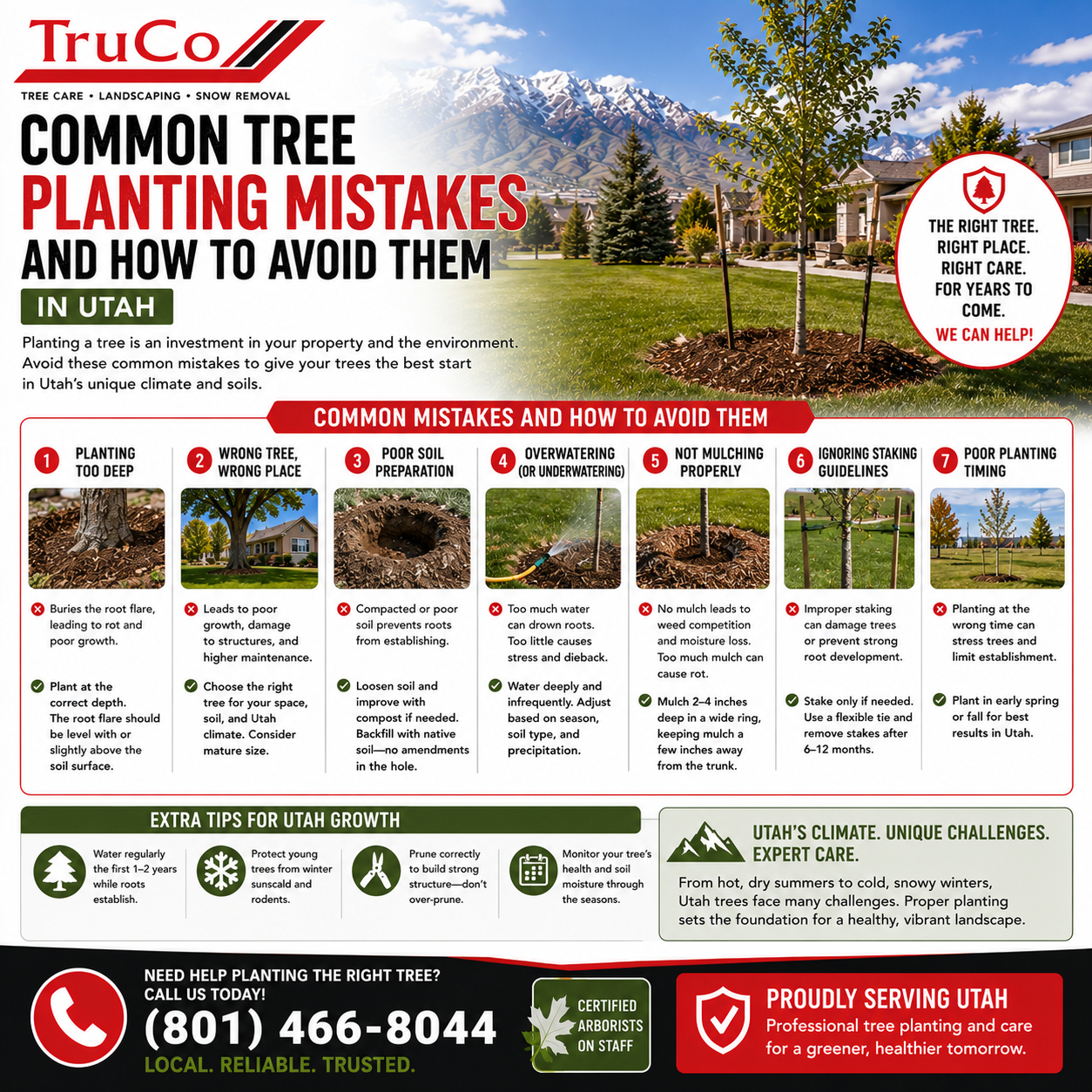
Why Tree Planting Mistakes Matter in Utah
Planting a tree seems simple — dig a hole, put the tree in, cover it up. But in Utah's challenging conditions — alkaline clay soil, semi-arid climate, and extreme temperature swings — planting mistakes can mean the difference between a tree that thrives for decades and one that struggles and dies within a few years. Studies from Utah State University Extension show that up to 70% of newly planted trees fail within the first five years due to preventable planting errors. The good news: most common mistakes are easy to avoid once you know what to watch for. Whether you are planting in Salt Lake City, Provo, Ogden, or anywhere along the Wasatch Front, understanding these common Utah tree planting mistakes will help your trees establish quickly and grow strong for generations.
Mistake #1: Planting Too Deep
Planting too deep is the most common and most deadly tree planting mistake in Utah. A tree planted too deep — where the root flare (the widening at the base of the trunk where roots begin) is below the soil line — will slowly suffocate and die. The buried trunk develops bark rot, adventitious roots may girdle the tree, and the tree never establishes properly. In Utah's heavy clay soil, deep planting is especially dangerous because the soil stays wet longer, accelerating trunk rot. The fix: plant high. The root flare must be visible above the soil line after planting. Dig the hole no deeper than the root ball's height. In clay soil, plant the root ball 1-2 inches above the surrounding grade. If the root ball is in a wire basket or burlap, remove as much of these materials as possible from the top and sides (burlap can wick moisture away from roots). Remove the top third of the wire basket. For container-grown trees, check for and correct girdling roots — roots circling the root ball — before planting.
Mistake #2: Digging the Wrong Size Hole
The hole you dig has a major impact on tree establishment. Two common mistakes are digging too deep (see above) and digging too narrow. A narrow hole restricts root expansion and creates a "flower pot" effect where roots circle within the hole and never spread into the surrounding soil. The fix: dig a wide hole. The hole should be 3-5 times the width of the root ball but no deeper than the root ball height. The wide hole loosens the surrounding soil, making it easier for roots to spread. For Utah clay soil, rough up the sides of the hole with a shovel or garden fork — smooth clay sides can deflect roots and prevent them from penetrating the native soil. Do not amend the entire hole with rich soil or potting mix — this creates a contrast between the planting hole and native soil that can discourage root spread. Instead, use the native soil as backfill, amending it 20-30% with compost or organic matter.
Mistake #3: Choosing the Wrong Tree Species
Selecting a tree species not suited to Utah's conditions is a common and costly mistake. Many popular trees from national big-box retailers are not adapted to Utah's alkaline soil, dry climate, and cold winters. Trees like river birch, red maple, and flowering dogwood will struggle or die in Utah's high-pH clay soil. The fix: choose Utah-adapted species. Select trees that tolerate alkaline soil (pH 7.5-8.5), cold hardiness (USDA zones 4-5 for most of the Wasatch Front, zones 5-7 for lower elevations), and drought once established. Recommended trees for Utah include honeylocust, Kentucky coffeetree, bur oak, serviceberry, goldenrain tree, and Austrian pine. Consider the tree's mature size — many homeowners plant trees too close to houses, power lines, or other structures. A tree that matures at 60 feet tall should be planted at least 25-30 feet from your house. Research your tree's specific needs before buying. Utah State University Extension publishes excellent tree selection guides for Utah conditions.
Mistake #4: Over- or Under-Watering After Planting
Improper watering after planting is a leading cause of tree failure in Utah. Both overwatering and underwatering are common. Overwatering in Utah's clay soil suffocates roots and promotes root rot. Underwatering during Utah's hot, dry summers desiccates roots and kills the tree. The fix: water correctly for your soil and climate. For newly planted trees in Utah clay, water every 5-7 days during the growing season (not daily). Water slowly so it penetrates deeply — a 5-gallon bucket with a small hole or a slow trickle from a hose works well. Water the root ball area, not just around it. In sandy or loamy soils, water more frequently (every 3-5 days). Use a moisture meter or check soil moisture 4-6 inches deep before watering. The soil should be moist but not saturated. As the tree establishes (months 6-12), gradually reduce watering frequency but increase the volume per watering. By year two, transition to the established tree schedule of deep watering every 7-14 days. Always water deeply rather than frequently — deep watering encourages deep root growth, while shallow watering encourages shallow, vulnerable roots.
Mistake #5: Mulching Incorrectly (Volcano Mulching)
"Volcano mulching" — piling mulch high against the trunk — is a widespread and damaging practice. Mulch piled against the trunk traps moisture, causes bark rot, provides cover for rodents that gnaw bark, and encourages roots to grow into the mulch rather than the soil. The fix: mulch properly. Apply 3-4 inches of organic mulch (wood chips, bark) over the root zone, extending from the trunk to the drip line. Keep mulch 3-6 inches away from the trunk — you should be able to see the root flare. Mulch in a flat, even layer, not mounded. Proper mulching conserves moisture, moderates soil temperature, suppresses weeds, and adds organic matter to the soil as it decomposes. In Utah, where clay soil compacts easily, proper mulching is even more important because it improves soil structure over time. Refresh mulch annually in spring or fall. Do not use rubber mulch or landscape fabric under mulch — these do not provide the same benefits as organic mulch and can harm soil health.
Mistake #6: Staking Incorrectly or Too Long
Staking is often overdone or left on too long, causing more harm than good. Trees that are staked too tightly or for too long develop weak trunks that cannot support themselves. Staking materials left on too long can girdle (strangle) the trunk as the tree grows. The fix: stake only when necessary and remove stakes promptly. Stake a tree only if it is in a windy location, has a large canopy relative to its root ball, or is a top-heavy species. Use flexible ties (arborist tape, wide fabric strips) that will not damage the bark. Attach ties to the lower half of the trunk — the top half needs to move to develop trunk strength. Remove stakes after one growing season. The goal is to allow the trunk to move slightly in the wind, which stimulates trunk taper and root development. A tree that is rigidly staked for years will be weak and may fail after the stakes are removed. In Utah, where spring winds can be strong, staking may be necessary for the first year for trees planted in exposed locations. Check stakes and ties regularly for tightness and adjust as the tree grows.
Mistake #7: Planting at the Wrong Time of Year
Timing matters for tree planting success in Utah. Planting in mid-summer when temperatures are above 90°F puts extreme stress on the new tree. Planting too late in fall (November or later) gives the tree insufficient time to establish roots before the ground freezes. The fix: plant at the optimal time. In Utah, the best time to plant trees is fall (September through October). Fall planting allows the tree to establish roots during the cool, moist months before winter dormancy, then be ready for strong spring growth. The second-best time is early spring (March through April), as soon as the ground is workable. Avoid planting in July and August unless you are prepared to water heavily and protect the tree from heat stress. For container-grown trees, which have less transplant shock than bare-root trees, the planting window is wider. However, even container trees benefit from fall or spring planting. If you must plant in summer, plant on a cool day, water thoroughly, provide shade if possible, and monitor soil moisture daily.
Mistake #8: Failing to Prepare the Soil Properly
Many homeowners plant trees without considering Utah's challenging soil conditions. Planting in unamended heavy clay, or in soil with construction debris, leads to poor establishment. The fix: prepare the soil properly. Before planting, test your soil pH (Utah State University Extension offers low-cost soil testing). If pH is above 7.5, choose alkaline-tolerant species and consider incorporating elemental sulfur to lower pH. Remove turf grass and weeds from a 4-6 foot diameter area around the planting site — grass competes with the new tree for water and nutrients. Loosen the soil in a wide area (not just the planting hole) to encourage root spread. Incorporate 20-30% organic matter (compost, aged manure) into the backfill. Do not add fertilizer to the planting hole — wait until the tree is established (usually one year after planting) before fertilizing. In compacted Utah clay soils, consider planting in a raised bed or berm to improve drainage. For trees in areas with poor drainage, install a French drain or drainage tile before planting. Proper soil preparation is an investment that pays off in years of healthy tree growth.
Frequently Asked Questions
How do I know if I planted my tree too deep? Check the root flare — the widening at the base of the trunk where the first major roots emerge. The root flare should be visible above the soil line. If the trunk goes straight into the ground like a telephone pole, the tree is planted too deep.
Should I remove the burlap or wire basket when planting? Yes, as much as possible. Remove burlap from the top and sides of the root ball (burlap wicks moisture away from roots). Cut away the top third of the wire basket. Natural burlap will decompose in 1-2 years, but synthetic burlap will not — check with your nursery.
How much should I water a newly planted tree? For Utah clay soil: water thoroughly at planting, then every 5-7 days during the growing season. Water slowly so it penetrates 12-18 inches deep. In sandy soil, water every 3-5 days. Reduce frequency in fall and increase in summer heat.
Can I plant a tree in Utah in the summer? It is not ideal, but it can be done with extra care. Plant on a cool day, water thoroughly, provide temporary shade, and monitor soil moisture carefully. Fall or spring planting is strongly recommended for best results.
What is the best fertilizer for a newly planted tree in Utah? Do not fertilize at planting time. Wait one year for the tree to establish. Then use a slow-release, low-phosphorus fertilizer formulated for alkaline soils. Avoid high-nitrogen fertilizers that burn tender roots.
How long does it take for a newly planted tree to establish? Most trees take 2-3 years to become fully established, meaning they can survive on normal watering without special care. Some slow-growing species may take 4-5 years. The establishment period is the most critical time for tree care.