
Tree Maintenance for Utah Commercial Properties

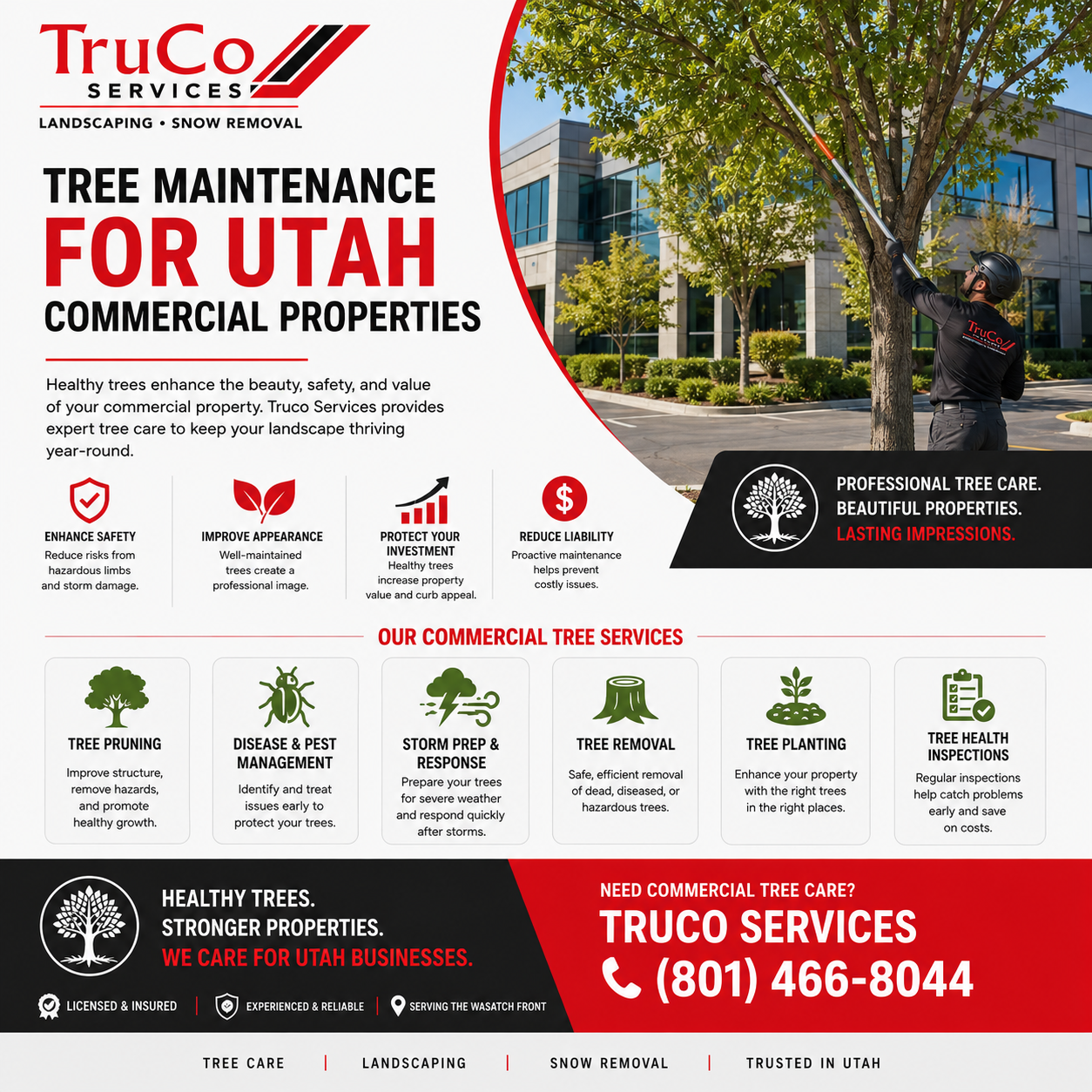
Why Commercial Tree Maintenance Matters for Utah Businesses
Commercial tree maintenance is a critical investment for Utah businesses. Healthy, well-maintained trees enhance curb appeal, create welcoming environments for customers and employees, and contribute to higher property values. For commercial properties along the Wasatch Front — from Salt Lake City office parks to Park City resort properties — professional tree care protects your landscaping investment and reduces liability risks. Neglected trees can become hazardous, leading to property damage, personal injury claims, and negative impressions. Regular maintenance by certified arborists helps Utah businesses comply with local ordinances, maintain safe premises, and preserve the aesthetic standards that attract clients and tenants.
Essential Tree Services for Commercial Properties
Commercial properties in Utah require a comprehensive approach to tree maintenance. Key services include pruning — crown cleaning, thinning, raising, and reduction to maintain structure and clearance; tree health assessments to identify pests, diseases, and nutrient deficiencies early; deep root fertilization to support tree vigor in Utah's alkaline clay soils; pest and disease management for common issues like aphids, scale, and cytospora canker; cabling and bracing for structural support of valuable trees; tree removal when trees become hazardous; stump grinding to eliminate tripping hazards; and emergency storm response for after wind or snow events. Many Utah commercial property managers contract for annual maintenance programs that include scheduled inspections and routine care throughout the growing season.
Tree Risk Assessment and Liability Reduction
Utah commercial property owners have a legal duty to maintain safe premises. Tree-related liability is a significant concern — falling branches or failing trees can cause injury, property damage, and costly lawsuits. A professional tree risk assessment evaluates the structural integrity of each tree on your property, identifying defects such as cracks, decay, codominant stems, root damage, and lean. In Utah's variable climate, freeze-thaw cycles, heavy snow loads, and spring winds can weaken trees. Arborists use a standardized risk rating system (low, moderate, high, and extreme) to prioritize action. Regular risk assessments — typically annually for commercial properties — document your due diligence and help defend against liability claims. Cost: $200-$500 per assessment depending on property size and tree count.
Pruning for Safety, Health, and Appearance
Pruning is the foundation of commercial tree maintenance. For Utah commercial properties, key pruning objectives include safety pruning — removing dead, dying, broken, or hazardous branches over walkways, parking areas, and buildings; clearance pruning — raising the canopy for vehicle and pedestrian access, typically 14-16 feet over drive aisles and 8-10 feet over sidewalks; structural pruning — improving branch architecture and reducing future risk; view preservation — selective thinning to maintain desired sight lines; and aesthetic pruning — shaping trees for a uniform, professional appearance. Proper pruning follows ANSI A300 standards and avoids topping, lion-tailing, or over-thinning. Commercial pruning costs in Utah typically range from $150-$500 per tree, depending on size and complexity.
Irrigation and Water Management for Commercial Trees
Utah's semi-arid climate requires careful irrigation management for commercial trees. Many commercial properties in Utah rely on automated irrigation systems that may not meet trees' needs. Common problems include overwatering from turf irrigation schedules, which can cause root rot and iron chlorosis; underwatering of trees in parking lot islands or along building perimeters; inefficient watering from poorly designed systems; and winter drought stress when irrigation systems are turned off. Best practices for commercial tree irrigation include installing deep root watering stations for high-value trees, adjusting irrigation zones to separate turf and tree watering needs, using smart controllers that adjust for weather and soil moisture, and mulching root zones to retain moisture. Consulting with an irrigation specialist and arborist can optimize your system for tree health while conserving water.
Utah-Specific Pest and Disease Management
Commercial trees in Utah face specific pest and disease pressures. Common issues include aphids and scale insects (honeydew drips on vehicles and walkways create sticky messes), spider mites (thrive in hot, dry conditions along the Wasatch Front), cytospora canker (affects spruce trees, common in Utah landscapes), pine needle scale (damages pines, common in commercial plantings), bacterial wetwood (slime flux on elms and poplars), and powdery mildew (affects many species in Utah's climate). Commercial properties benefit from proactive integrated pest management (IPM) programs that identify problems early and use targeted treatments. Treatment options include horticultural oils, insecticidal soaps, systemic insecticides, and biological controls. Regular monitoring every 2-4 weeks during the growing season catches issues before they become visible to customers and tenants.
Seasonal Commercial Tree Care Calendar
Spring (March-May): Conduct tree risk assessments after winter snow melt. Apply pre-emergent weed control in mulched beds. Inspect for winter damage and breakage. Begin pruning (dormant pruning is best for most species). Apply iron chelate treatments for chlorotic trees. Summer (June-August): Monitor irrigation and adjust for heat. Monitor for pests and diseases weekly. Deadwood pruning as needed. Apply supplemental deep watering during drought. Watch for storm damage. Fall (September-November): Schedule major pruning after leaf drop. Apply deep root fertilization. Plant new trees (fall is ideal planting season). Prepare for winter — cabling and bracing for weak branches. Winter (December-February): Conduct structural pruning (dormant season). Monitor for snow and ice accumulation. Schedule major tree work while ground is frozen. Plan spring maintenance programs. Schedule contractor bids for the coming year.
Commercial Tree Maintenance Contracts
Many Utah commercial properties benefit from annual tree maintenance contracts. These agreements typically include a set number of visits per year, discounted rates on additional services, priority scheduling, and documentation for insurance and compliance purposes. A typical commercial contract for a mid-size property (20-50 trees) in the Salt Lake Valley costs $2,000-$5,000 per year, depending on services included. Contracts can be structured as basic inspection and pruning packages, comprehensive care including fertilization and pest management, or full-service programs covering all tree-related needs. When selecting a contractor, verify that they have International Society of Arboriculture (ISA) certification, proper insurance, Utah business licenses, and references from similar commercial properties in your area.
Tree Preservation During Construction
Utah's construction boom means many commercial properties undergo renovations or new development. Protecting existing trees during construction is critical — soil compaction, root cutting, grade changes, and equipment damage can kill or destabilize trees. Best practices include establishing tree protection zones (TPZs) around all trees to be preserved (fencing at the drip line), avoiding soil compaction by keeping equipment outside TPZs, tunneling rather than trenching near tree roots, mulching heavily within TPZs to protect roots, and monitoring soil moisture during construction. A certified arborist should conduct pre-construction assessments and monitor trees throughout the project. Costs for tree protection plans typically range from $500-$2,000, far less than the cost of replacing a mature specimen tree valued at $5,000-$20,000.
Emergency Tree Services for Utah Commercial Properties
Utah's weather can create tree emergencies at any time. Spring windstorms, heavy wet snow, and microbursts can cause sudden tree failure. Commercial properties need a plan for after-hours tree emergencies. Establish a relationship with a tree service that offers 24/7 emergency response. Have contact information readily available for property managers and maintenance staff. Document all emergency tree work with photos and written reports for insurance purposes. Typical emergency response costs $500-$2,000 depending on the scope of work. Commercial properties with proactive maintenance programs experience fewer emergencies, as regular pruning removes hazardous branches before they fail. However, even well-maintained trees can fail in extreme weather, and a prepared response plan minimizes disruption to your business operations.
Frequently Asked Questions
How often should commercial trees be inspected? At least annually, with additional inspections after major storms. High-traffic properties should consider semi-annual inspections for liability management.
Who is liable if a tree on my commercial property damages a vehicle? The property owner is generally liable if the tree was known to be hazardous or if a reasonable inspection would have identified the hazard. Regular arborist inspections and maintenance documentation are your best defense.
Can tree maintenance be tax deductible for commercial properties? Yes. Routine tree maintenance is typically deductible as a business expense. Major tree work that increases property value may need to be capitalized. Consult your accountant. References: Utah Tax Commission guidelines.
What certifications should a commercial tree service have? ISA Certified Arborist credentials are essential. Look for Tree Care Industry Association (TCIA) accreditation and proper liability insurance (minimum $2 million general liability). Utah requires business licensing.
How do I know if a tree on my commercial property is hazardous? Signs include dead branches, cracks in the trunk or major limbs, decay or fungal growth at the base, leaning after storms, exposed or damaged roots, and codominant stems with included bark. A certified arborist should evaluate any tree showing these signs.
What is the best time of year for commercial tree pruning in Utah? Late fall through early spring (dormant season) is generally best. Pruning during dormancy minimizes stress, reduces pest attraction, and gives a clearer view of branch structure. However, safety pruning can be done anytime.