
Bountiful UT Permanent Christmas Lights

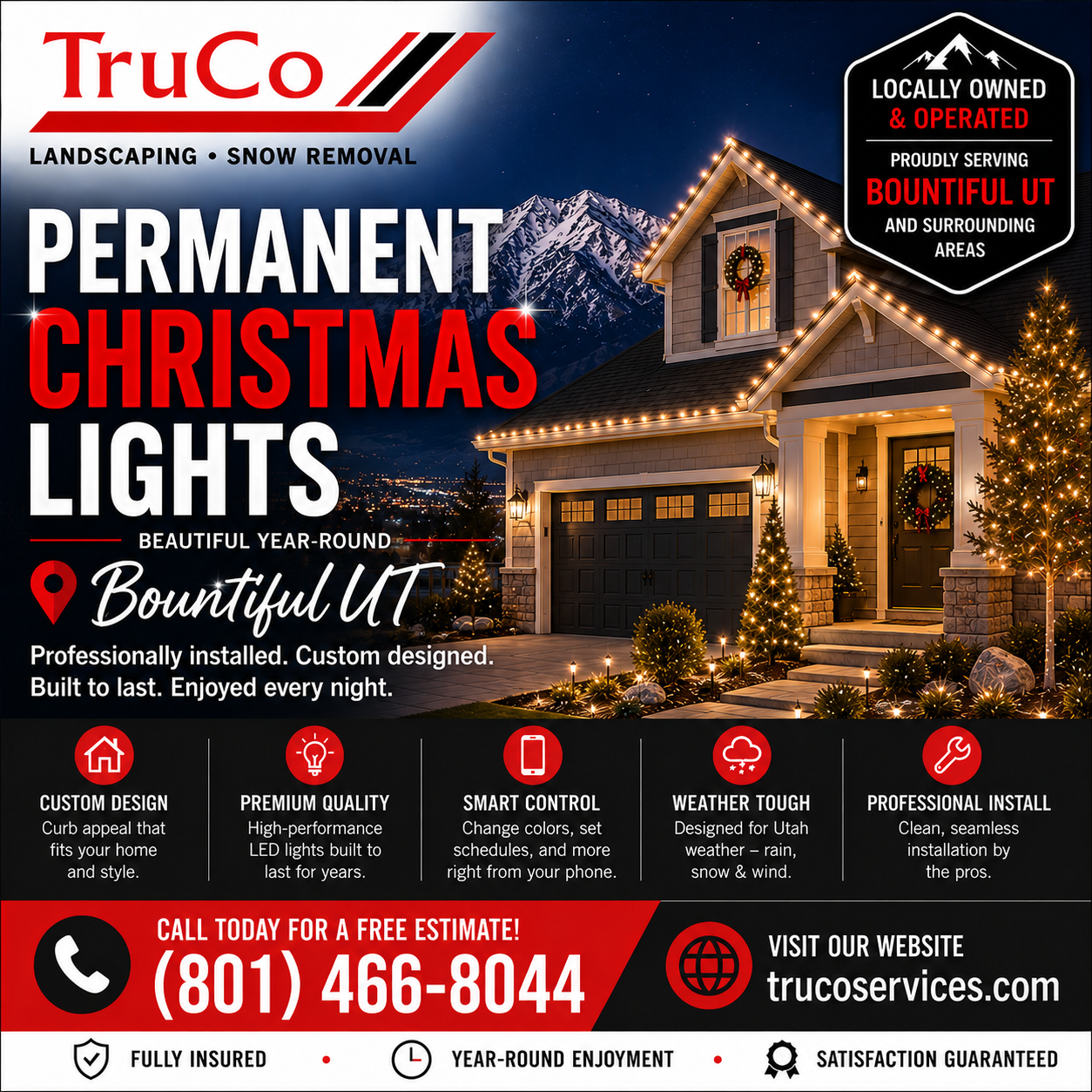
Bountiful UT permanent Christmas lights are professionally installed exterior LED lighting systems that stay mounted on your home all year while allowing you to change colors, brightness, schedules, and patterns through an app, controller, remote, or timer. They replace the annual routine of climbing ladders, hanging temporary strings, managing extension cords, and taking everything down after the holidays.
The most important point is that permanent holiday lighting is an exterior improvement, not a disposable decoration. A successful system depends on thoughtful roofline design, outdoor-rated materials, clean wiring, proper mounting, safe power planning, and a provider who can explain future service and warranty coverage clearly. Poor installation can lead to crooked tracks, visible wiring, dim sections, water-related failures, roofline damage, difficult repairs, and unexpected electrical concerns.
This guide is for Bountiful homeowners comparing permanent Christmas light options, researching their first installation, planning around a roof replacement, or trying to avoid expensive mistakes. It explains how permanent lighting works, what can go wrong, local electrical considerations, options and alternatives, cost factors, and how Truco Services can help plan a system that looks polished in every season.
What Are Bountiful UT Permanent Christmas Lights?
Permanent Christmas lights are low-profile LED lighting systems installed along selected parts of a home’s exterior. Common locations include soffits, fascia boards, rooflines, garage edges, front gables, dormers, entryways, patio covers, and other architectural details.
Unlike traditional seasonal Christmas lights, permanent exterior lights remain installed after the holidays. The lighting hardware is intended to blend into the exterior during the day, while the LED modules provide programmable accent lighting at night.
Most modern Bountiful permanent holiday lighting systems include:
Individually controlled LED light modules or “pucks.”
A mounting track or channel that maintains even spacing and conceals wiring.
Outdoor-rated wire, connectors, and weather-protected connections.
A controller for colors, patterns, brightness, zones, and schedules.
A power supply or appropriate electrical connection.
A mobile app, remote, timer, or local control method.
Installation, testing, programming, and homeowner instruction.
For example, a homeowner may use a soft warm-white roofline setting for everyday curb appeal, red and green for December, orange and purple for Halloween, red-white-and-blue for Independence Day, or custom colors for birthdays, school events, and family celebrations.
How the Installation Process Works
A professional permanent lighting project usually begins with an exterior evaluation. The provider measures rooflines, looks at soffits and fascia, considers access, identifies likely power locations, discusses the desired look, and asks about future exterior projects such as roofing, painting, solar panels, or gutter replacement.
Once the design is approved, the installer mounts the track or lighting components, routes wire cleanly, installs the controller and power equipment, tests every section, and configures the system. You should receive a hands-on walkthrough before the project is finished.
The electrical scope is important. Bountiful City’s code states that electrical additions or alterations generally require a permit before wiring is installed or electrical equipment is added, except for limited minor repair work. Do not assume every permanent lighting project has the same permitting needs. The appropriate requirements depend on whether the installation uses an existing plug-in connection or includes new outlets, circuits, hardwired equipment, service changes, or other electrical modifications.
9 Important Things to Know
1. The Design Should Fit Your Home, Not a Generic Template
The best Bountiful UT permanent Christmas lights highlight the parts of your home that look best from the street. That sounds simple, but it is the foundation of a successful project.
A small rambler, a two-story home, a home with deep soffits, a house with multiple garage bays, and a property with several prominent peaks each need a different lighting plan. A generic “per-foot” quote does not automatically produce a balanced design.
Start by standing across the street and identifying the main visual lines of your home. The front roofline, garage, gables, dormers, porch roof, and entryway are common focal points. You may not need to illuminate every side of the house. In many cases, a carefully selected front-facing layout looks more polished than a system that outlines every available edge.
For example, a large gable may look unfinished if only one side is lit. But outlining every small roof return can make the home appear busy. The best design has visual balance: major architectural lines are supported, spacing stays consistent, and no one section feels unexpectedly dark or overly bright.
A good provider should discuss whether you want:
A simple front roofline display.
Full front-elevation lighting.
Lighting on visible side elevations.
Garage and peak accents.
Patio, backyard, or entertainment-area lighting.
Everyday warm-white lighting in addition to holiday colors.
Ask for a detailed scope that shows exactly what is included. Confirm whether the price covers upper-level rooflines, gables, garage edges, track color, controller placement, wire concealment, programming, and future service. Clear planning helps prevent the common disappointment of discovering that the “whole-home” quote only included a limited, easy-to-reach area.
2. Quality Depends on the Entire System
The LEDs are important, but they are only one part of a permanent holiday lighting system. Long-term reliability also depends on the mounting track, wiring, connectors, controller, power supply, weather seals, fasteners, and installation methods.
A quality system should be designed for permanent exterior use. It should have outdoor-rated components, connectors appropriate for moisture exposure, stable color performance, and wiring that can tolerate Utah’s sun, cold, snow, and seasonal temperature swings.
The mounting track is especially important for appearance. It provides even spacing, supports the light modules, and hides wiring. A track that matches the soffit or fascia can blend into the exterior; a mismatched or poorly aligned track can be visible from the street all year.
Poor-quality systems may initially look fine but develop problems such as:
Faded or brittle plastic components.
Loose tracks or fasteners.
Moisture intrusion at connections.
Flickering or inconsistent colors.
Dimming near the end of long runs.
App or controller failures.
Difficult-to-source replacement parts.
Before choosing a system, ask what brand and product line will be used. Ask whether parts can be repaired, whether individual modules can be replaced, and how long replacement components are expected to be available.
Also ask whether the provider will install a dedicated track or simply attach exposed wires and lights directly to the exterior. The lowest-cost approach can look acceptable at night but may look unfinished in daylight. Because these lights remain installed year-round, daytime appearance should be part of the quality standard.
3. Bountiful Weather Requires Durable Materials and Proper Mounting
Bountiful homes experience bright sun, winter snow, wind, freezing temperatures, moisture, and repeated expansion-and-contraction cycles. Those conditions make careful installation more important than many homeowners realize.
Sun exposure can degrade low-quality plastics, adhesives, cable jackets, and unprotected components. Winter freeze-thaw cycles can expose weak mounting methods. Wind and snow may pull on loose wire runs or tracks that were not properly secured. Water can enter poorly protected connections and create intermittent failures.
A durable permanent Christmas lighting installation should account for:
UV exposure on south- and west-facing elevations.
Snow and ice near rooflines and gutters.
Wind exposure on open lots and elevated properties.
Expansion and contraction of tracks and trim.
Access for future repairs or exterior maintenance.
The installer should explain how the system is mounted and why the mounting method is appropriate for your home’s soffits, fascia, siding, stucco, brick, or other materials. Lighting should not be installed in a way that compromises shingles, flashing, gutters, ventilation, or drainage.
Permanent holiday lights are usually attached to soffit, fascia, trim, or purpose-built channels—not carelessly fastened through roofing materials. If a provider proposes drilling through shingles or placing hardware where it may interfere with water flow, ask detailed questions before approving the work.
A weather-ready installation protects both your lighting investment and the home itself. The goal is not simply for the lights to work on Christmas night; it is for the system to remain secure, aligned, and functional after years of changing weather.
4. Electrical Planning Protects Safety and Reliability
LED permanent lighting typically uses much less power than older incandescent Christmas strings. That does not make electrical planning optional. A permanent outdoor lighting system still needs an appropriate power source, protected connections, correct equipment, and installation consistent with local rules and manufacturer instructions.
Bountiful City’s code states that no additions or alterations may be made to existing wiring, no new wiring may be installed, and no apparatus that generates, transmits, transforms, or uses electricity may be installed without first obtaining a permit—except for specific minor repairs.
This does not mean every plug-in lighting system will require the same permitting process. It means homeowners should verify the actual scope of work rather than assuming. A system that plugs into an existing suitable outdoor receptacle may be different from one that requires a new circuit, a hardwired transformer, a service-panel modification, or a new exterior outlet.
Ask these questions before work begins:
Where will the system receive power?
Is the existing outlet suitable for the equipment?
Will any new circuit, exterior outlet, or hardwired connection be added?
Is GFCI protection relevant to the proposed power setup?
Who will handle the electrical work?
Is a permit or inspection required for this scope?
How will the power supply and connections be protected from weather?
Will wiring be exposed, concealed, or routed through a protected pathway?
Bountiful’s published electrical-service policy also notes that service changes and certain panel-related work require permits and must comply with relevant electrical requirements.
Do not rely on long-term extension cords, overloaded outlets, or improvised splices. Proper power planning improves safety, reduces failures, and makes future servicing much easier.
5. Daytime Appearance Is Just as Important as Nighttime Color
A permanent lighting system is visible when it is turned off. This is why the daytime appearance of tracks, wires, connectors, junctions, and controllers is one of the most important factors in a successful installation.
At night, color-changing LEDs can look impressive even when the installation details are mediocre. In daylight, however, crooked tracks, exposed wire, mismatched colors, loose connectors, and poorly located controller boxes become obvious.
A well-installed system should meet these daytime standards:
The track blends with the soffit, fascia, or trim whenever possible.
Light modules are evenly spaced and aligned.
Corners and transitions look intentional.
Wires are concealed or routed cleanly.
Controller and power equipment are accessible but discreet.
No components interfere with gutters, downspouts, vents, or trim.
The home’s exterior remains visually clean when lights are off.
Request daytime photos of past work. Do not make a decision based solely on dramatic nighttime images. Nighttime photos show color and brightness; daytime photos show craftsmanship.
Controller placement deserves special attention. A controller hidden inside a garage may be protected but could have Wi-Fi signal limitations. A controller placed outdoors may offer better access but needs proper weather protection. Your provider should explain where it will go and why.
The best Bountiful permanent lighting installations are obvious at night and nearly invisible during the day. That is the standard homeowners should expect from a long-term exterior upgrade.
6. Controls, Zones, and Brightness Determine Daily Usability
Permanent lighting is more useful when it is easy to control. Many modern systems offer smartphone apps, but not all apps provide the same flexibility.
Basic systems may allow you to choose colors and a few preprogrammed patterns. More advanced permanent Christmas light systems can create zones, schedule automatic on-and-off times, save holiday presets, adjust brightness, set custom patterns, and let multiple members of the household use the controls.
Before selecting a system, think about how you will actually use it. A homeowner who wants only red and green during December may not need extensive zone control. Someone who wants warm-white lighting year-round, team colors for game days, individual colors for different rooflines, and event-specific patterns may benefit from a more capable controller.
Consider these features:
App, remote, Bluetooth, Wi-Fi, or local-controller operation.
Brightness adjustment.
RGB versus RGBW light quality.
Warm-white settings.
Multiple zones or independently controlled sections.
Schedules and timers.
Custom patterns and saved scenes.
Operation during an internet outage.
Ability to share access with family members.
RGB systems create colors by mixing red, green, and blue. RGBW systems include a dedicated white LED, which may provide more natural-looking white light for everyday architectural accent lighting. If you expect to use permanent lights outside holiday periods, this distinction can matter.
Brightness is equally important. Overly bright lights can create glare, shine into bedroom windows, or annoy nearby neighbors. The best system is not necessarily the brightest one; it is the one that can be dimmed and programmed thoughtfully for different situations.
7. Warranty Language Must Be Specific
Permanent Christmas light warranties can be confusing because “lifetime” or “long-term” coverage may apply only to parts, not labor. A manufacturer may replace a defective component but not cover the cost of diagnosing the issue, accessing a second-story roofline, removing a track, or reinstalling equipment.
Installation warranties can also have exclusions. Common exclusions may include storm damage, roof work, painting, pests, accidental damage, homeowner modifications, electrical surges, or work performed by another contractor.
Before hiring a provider, get these answers in writing:
How long are the lights covered?
How long are tracks, wiring, controllers, and power supplies covered?
Is the installation workmanship covered separately?
Are labor and service calls included?
Are diagnostics included if a section stops working?
Who handles manufacturer warranty claims?
What happens if a roofer, painter, gutter installer, or solar company damages the system?
Can the warranty transfer to a future owner?
What service fees apply after the labor warranty ends?
A written warranty is only useful if you understand what it means in real life. Do not assume that “lifetime” means no future cost. Instead, focus on clarity: who answers the call, who diagnoses the issue, who pays for labor, and how the provider handles difficult-access repairs.
Keep your agreement, product details, installation photos, control instructions, app login, warranty documents, and service contact information. Good records make future troubleshooting much easier.
8. Plan Around Roof, Gutter, Paint, and Solar Work
Permanent roofline lighting becomes part of your home’s exterior maintenance plan. That means future roofing, gutter replacement, siding repairs, painting, soffit work, fascia repairs, and solar installation can affect the system.
A roofer may need access to the same fascia or soffit area where your lights are installed. A gutter company may need to remove or modify components near the roof edge. A painter may need to protect tracks or remove portions temporarily. Solar installers may need access to rooflines and electrical pathways.
If those contractors are not told about the permanent lighting system before work begins, they may accidentally damage wire, tracks, light modules, connectors, or control equipment. The repair may not be covered under the lighting warranty because the damage was caused by a third party.
If your roof is nearing the end of its expected service life, consider completing roofing work before installing permanent Christmas lights. Otherwise, you may need to pay for removal and reinstallation sooner than expected.
Before any exterior project begins:
Tell the contractor permanent lighting is installed.
Identify controller and power locations.
Photograph light tracks and wire routes.
Ask the lighting provider whether removal and reinstallation services are available.
Confirm whether third-party work affects warranty coverage.
Get a written plan for protecting or temporarily removing the system.
Planning ahead prevents a convenience upgrade from becoming an obstacle to necessary home maintenance.
9. The Lowest Price Is Not Always the Best Value
Permanent lighting quotes can vary widely because they may cover very different scopes of work. One estimate may include only the easiest front roofline. Another may include garage lines, gables, upper elevations, matching tracks, protected wiring, app setup, electrical coordination, warranty coverage, and ongoing service.
That means a lower price does not always represent a better deal.
An unusually low bid may exclude quality components, upper rooflines, concealed wiring, electrical work, programming, service visits, or a meaningful warranty. Ask what is excluded, not just what is included.
Permanent exterior lighting should be evaluated as a long-term home improvement. Choose a provider based on quality, clarity, service, and design—not simply the lowest price.
Frequently Asked Questions
What are permanent Christmas lights?
Permanent Christmas lights are exterior LED lighting systems installed on a home year-round. They can display holiday colors, warm-white accent lighting, event colors, patterns, and scheduled scenes.
Are permanent Christmas lights only for Christmas?
No. They can be used for Halloween, Independence Day, birthdays, sports events, parties, warm-white roofline accent lighting, and other celebrations.
Do permanent lights stay on all year?
The physical system remains installed, but the lights can be turned off whenever you want. Most systems offer schedules, timers, and app controls.
Can permanent Christmas lights be used as everyday lighting?
They can provide accent lighting and curb appeal, especially with warm-white settings. They are not necessarily a replacement for dedicated pathway, entry, security, or landscape lighting.
How are permanent lights controlled?
Many systems use a smartphone app. Depending on the system, users may also have remote, Bluetooth, Wi-Fi, timer, or local-controller options.
Can I dim permanent Christmas lights?
Most quality systems allow brightness adjustments. Dimming is useful for softer everyday lighting and for reducing glare near neighbors or bedroom windows.
What is RGBW lighting?
RGBW lighting uses red, green, blue, and a separate white LED. The dedicated white channel may produce more natural-looking warm or white light than RGB-only systems.
Do permanent lights work without Wi-Fi?
It depends on the system. Some need Wi-Fi for app access, while others may offer Bluetooth, remote, manual, or local-controller operation. Ask about offline control before purchasing.
Are permanent lights weatherproof?
The system should be designed for exterior use, but good installation still matters. Tracks, connectors, cable, controllers, power supplies, and mounting methods all need appropriate protection from moisture and weather.
Will snow damage permanent Christmas lights?
A suitable outdoor system should be selected and installed with snow, freezing temperatures, wind, and moisture in mind. Poor mounting, exposed connections, or weak materials increase failure risk.
Will permanent lights damage my roof?
They should not when installed correctly. Many systems mount to soffits, fascia, trim, or dedicated tracks rather than through roof shingles. Ask the provider to explain the mounting method.
Can permanent lights be installed on a two-story house?
Yes. Multi-story homes are common candidates, though roof access, safety needs, serviceability, and design complexity may affect installation cost.
Can permanent lights be installed on brick, stucco, vinyl, or wood?
Often, yes. The mounting method should be matched to the material. A provider should evaluate your specific exterior rather than use one approach everywhere.
How long do permanent Christmas lights last?
Lifespan varies with the product, weather exposure, operating schedule, installation quality, component quality, and warranty terms. Ask for manufacturer-specific information rather than relying on a general claim.
Are permanent lights expensive to operate?
LED systems generally use much less electricity than older incandescent holiday lights. Actual costs depend on the length of the system, brightness, operating hours, and local electric rates.
Can I add more lights later?
Some systems are expandable, but controller capacity, power limits, voltage drop, and maximum run length can limit future additions. Discuss expansion plans before installation.
What happens if one light stops working?
The answer depends on the system design. Some systems allow individual-module or segment repairs. Ask about diagnostic procedures, replacement parts, labor, and service fees.
Can permanent lighting be repaired?
Many systems can be repaired, depending on product availability, system age, component access, and the type of failure. A written service process is important.
Do permanent lights require maintenance?
They usually require much less seasonal work than temporary lights, but may still need occasional inspection, software updates, resetting, storm checks, or professional service.
Should I install permanent lights before replacing my roof?
If roof replacement is likely soon, it is often wiser to complete the roof first. Installing lights beforehand may create removal and reinstallation costs.
Can solar panels affect permanent lighting?
They can coexist, but roof access, wiring, mounting locations, and future maintenance should be coordinated between both projects.
Do I need a permit for permanent lights in Bountiful?
It depends on the electrical scope. Bountiful City’s code generally requires permits for additions or alterations to electrical wiring and for electrical equipment installations, except for limited minor repairs. Confirm the requirements for your exact project with the city or a qualified professional.
Can I use an existing outdoor outlet?
Possibly, but suitability depends on the outlet condition, circuit capacity, equipment requirements, weather protection, and applicable electrical rules. A professional should evaluate the proposed connection.
Are outdoor outlets required to have GFCI protection?
Outdoor electrical safety requirements depend on the outlet, installation, current adopted codes, and scope of work. Ask a qualified electrical professional or local building authority about the specific proposed setup.
Can permanent lights stay on overnight?
They can, but use reasonable brightness, appropriate schedules, and considerate settings. Avoid intense flashing patterns late at night, especially near neighboring homes.
Will permanent lights annoy my neighbors?
They can if overly bright, directed toward nearby houses, or operated with fast-changing patterns late at night. Dimming and schedules help maintain good neighbor relations.
Can permanent lights improve curb appeal?
A clean, balanced, professionally installed system can improve curb appeal. Visible wiring, crooked tracks, mismatched colors, or excessive brightness can have the opposite effect.
Do permanent lights add home value?
They may appeal to some buyers as a convenience and curb-appeal feature, but no resale increase is guaranteed. Quality, maintenance, serviceability, and daytime appearance matter.
Can permanent Christmas lights help with security?
They can add general exterior visibility but are not a complete security solution. Use dedicated motion lighting, entry lighting, locks, cameras, and alarms for a more comprehensive security plan.
What should I ask during an estimate?
Ask about exact rooflines included, product brand, track color, wire routing, controller location, app features, brightness, power needs, electrical scope, permits, warranty coverage, service fees, and removal/reinstallation options.
Rules and Standards to Know
Permanent exterior lighting involves electrical safety, building requirements, manufacturer instructions, and possibly HOA rules. This section is general information, not legal advice or a substitute for a project-specific code evaluation.
Bountiful electrical permits: Bountiful City’s code says electrical additions, alterations, new wiring, and electrical apparatus installations generally require a permit before work begins, with narrow minor-repair exceptions.
Electrical-service changes: Bountiful City’s published policy says residential service changes require a building permit and outlines compliance considerations for electrical-service upgrades, panels, meters, and related wiring.
Local jurisdiction matters: Davis County explains that permit responsibility depends on whether a property lies within a municipality’s jurisdiction or unincorporated county jurisdiction. If your property is near a jurisdiction boundary, confirm the correct authority before proceeding.
Manufacturer instructions: Outdoor lighting components should be installed according to the manufacturer’s listing, labeling, and instructions. Do not substitute unapproved connectors, overload equipment, modify wiring, or use temporary accessories as permanent components.
HOA approval: Some neighborhoods may regulate exterior improvements, track visibility, brightness, lighting hours, or architectural modifications. Review HOA rules before installation.
Conclusion
Bountiful UT permanent Christmas lights can make your home easier to decorate, more festive, and more visually appealing throughout the year. The right system lets you enjoy holidays, special events, and subtle warm-white architectural lighting without repeated ladder work or seasonal storage.
The best results come from planning before installation. Choose a roofline design that fits your home, use quality outdoor-rated materials, prioritize daytime appearance, plan power safely, understand local electrical requirements, review warranty terms, and coordinate around future roof or exterior work.
Most permanent lighting problems are avoidable when the system is designed and installed carefully from the start. For practical guidance on Bountiful UT permanent Christmas lights, contact Truco Services at (801) 466-8044 to discuss a system designed around your home, goals, and long-term exterior plans.