
Best Trees for Year-Round Color in Utah Landscapes

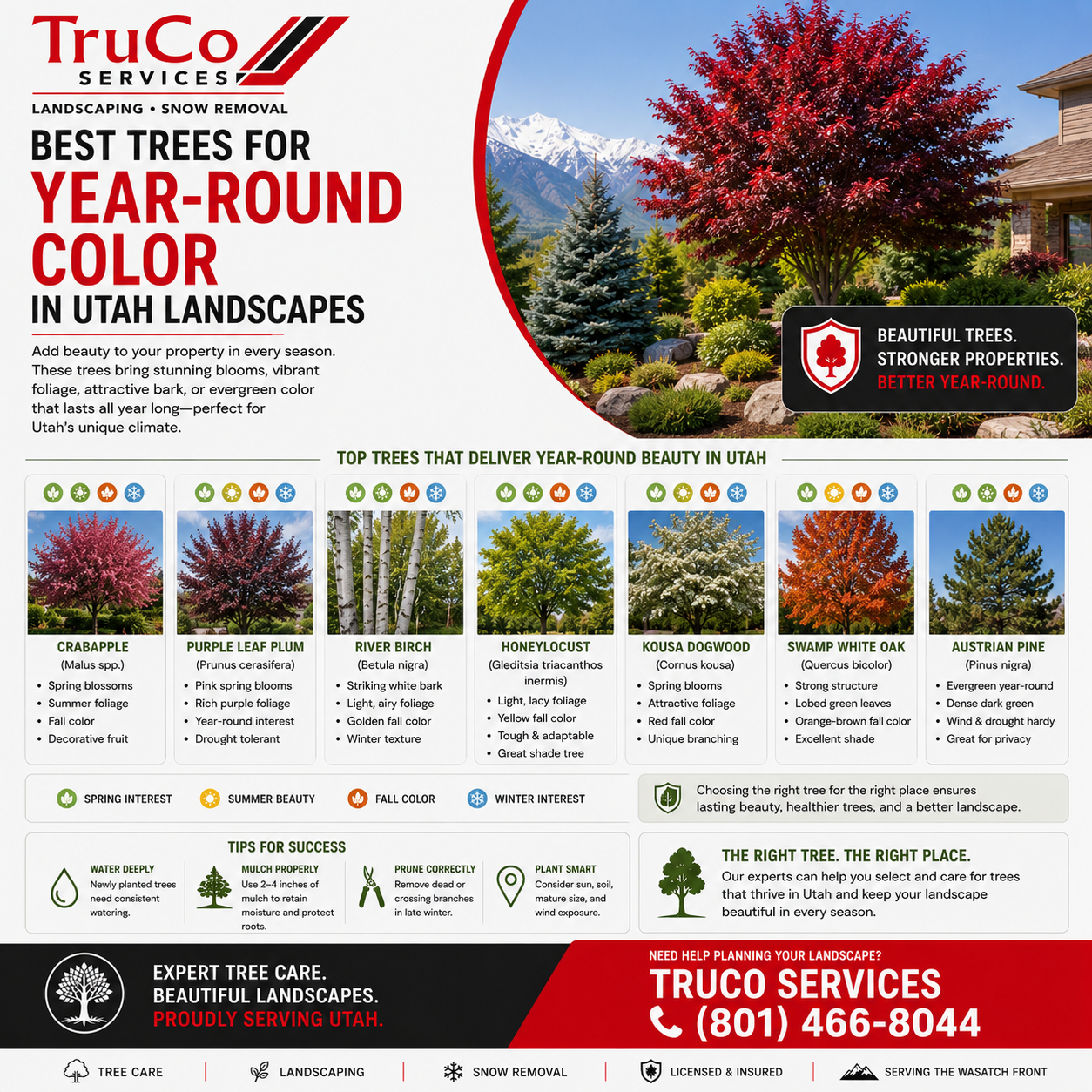
Creating Year-Round Color with Trees in Utah
Utah's four distinct seasons offer opportunities for trees that provide color throughout the year — from spring blossoms to summer foliage, autumn brilliance to winter bark and berries. While many landscapes focus on fall color alone, a thoughtfully designed tree planting can provide visual interest in every season. Utah's high-altitude climate, with its intense sun, cold winters, and alkaline soil, supports a wide range of trees with multi-season appeal. By selecting species that offer different seasonal highlights and layering them in your landscape, you can create a garden that is beautiful in January as well as July. This guide covers the best trees for year-round color in Utah landscapes, organized by the seasons they shine in most, with an emphasis on species that offer interest in multiple seasons.
Spring-Flowering Trees for Utah Color
Spring in Utah arrives dramatically — from the pink buds of redbud to the white clouds of serviceberry. Spring-flowering trees provide the first major color show of the year. Eastern redbud (Cercis canadensis) — spectacular pink-purple flowers that appear before leaves in early spring (March-April in Utah's valleys). Heart-shaped leaves provide summer interest. Grows 20-30 feet tall. Adaptable to various soils. The variety 'Forest Pansy' has purple foliage through summer. Flowering pear (Pyrus calleryana) — masses of white spring flowers. Glossy green summer foliage turns brilliant red-purple in fall. Grows 30-50 feet tall. Note: avoid invasive Bradford pear varieties; choose improved cultivars like 'Aristocrat' or 'Chanticleer.' Serviceberry (Amelanchier species) — white spring flowers, edible blue berries in summer, and brilliant orange-red fall color. Utah natives available. Grows 15-25 feet tall. Multi-season interest. Excellent for naturalistic landscapes. Golden chain tree (Laburnum × watereri) — pendulous chains of bright yellow spring flowers. Green summer foliage. Grows 15-25 feet tall. Short-lived but spectacular. All parts are toxic, so avoid where children play. Crabapple (Malus species) — profuse spring flowers in white, pink, red, or coral. Some varieties have persistent red or yellow fruit through winter. Grows 15-25 feet tall. Choose disease-resistant varieties like 'Spring Snow,' 'Prairiefire,' or 'Sugar Tyme.' Flowering plum (Prunus cerasifera) — pink or white spring flowers followed by purple foliage that retains color through summer. Grows 15-25 feet tall. The purple leaves provide summer color that most other trees don't offer.
Summer Foliage and Flower Color
Summer color comes from foliage and continued flowering. Japanese tree lilac (Syringa reticulata) — large, creamy-white flower clusters in June-July after most trees have finished blooming. Dark green summer foliage. Grows 20-30 feet tall. Excellent street tree for Utah. Goldenrain tree (Koelreuteria paniculata) — yellow summer flowers followed by papery seed pods that look like Japanese lanterns. Grows 30-40 feet tall. Tolerates heat, drought, and alkaline soil. Late summer interest when few other trees bloom. Catalpa (Catalpa speciosa) — large, showy white flowers with purple markings in June. Huge, heart-shaped leaves provide dense shade. Long seed pods in fall. Grows 40-60 feet tall. Unique tropical appearance for Utah landscapes. Purple-leaf plum (Prunus cerasifera 'Krauter Vesuvius,' 'Thundercloud') — deep purple foliage provides summer color contrast. Pink spring flowers. Grows 15-25 feet tall. Maintains purple color through summer heat. Smoke tree (Cotinus coggygria) — airy, smoke-like flower clusters in pink or purple summer through fall. Purple or gold foliage varieties available. Grows 10-15 feet tall. Excellent for summer color in small landscapes. Crape myrtle (Lagerstroemia indica) — long summer bloom period with flowers in pink, red, purple, or white. Attractive peeling bark in winter. Grows 10-20 feet tall. In Utah, choose cold-hardy varieties and plant in protected locations.
Brilliant Fall Color Trees for Utah
Utah's fall color is legendary, and the right trees can bring that brilliance to your property. Bigtooth maple (Acer grandidentatum) — Utah's native maple with spectacular orange-red fall color. Grows 20-40 feet tall. Prefers moist, well-drained soil but adapts to various conditions. Excellent for naturalistic landscapes in Utah's foothills and valleys. Freeman maple (Acer × freemanii) — hybrid of red and silver maple with brilliant red fall color, strong structure, and adaptability. Grows 40-60 feet tall. Cultivars like 'Autumn Blaze' and 'Sienna Glen' are excellent choices for Utah. Tolerates alkaline soil better than pure red maple. Quaking aspen (Populus tremuloides) — golden-yellow fall color with white bark for winter interest. Grows 40-60 feet tall. In Utah valleys, aspens struggle with heat and disease; best used at higher elevations or in protected, moist locations. Bur oak (Quercus macrocarpa) — russet-red to brown fall color that persists into winter. Grows 60-80 feet tall. Extremely adaptable to Utah's climate. Excellent for large landscapes. Honeylocust (Gleditsia triacanthos) — golden-yellow fall color with fine-textured foliage. Grows 40-60 feet tall. Provides light shade that allows grass to grow beneath. Thornless and seedless varieties are available. Ginkgo (Ginkgo biloba) — brilliant golden-yellow fall color that creates a spectacular display. Grows 50-80 feet tall. Pest-free and long-lived. Male cultivars like 'Autumn Gold' are recommended. One of the best fall-color trees for Utah. Shademaster honeylocust — consistent golden-yellow fall color. Tolerates alkaline soil, drought, and urban conditions. Grows 45-60 feet tall. Excellent, adaptable shade tree for Utah landscapes.
Winter Interest: Bark, Berries, and Evergreens
Winter doesn't have to be colorless, even in Utah. Paperbark maple (Acer griseum) — cinnamon-brown, peeling bark provides winter interest. Grows 20-30 feet tall. Slow-growing but spectacular. Brilliant red fall color adds to its appeal. River birch (Betula nigra) — peeling bark in shades of salmon, cream, and brown. Grows 40-70 feet tall. In Utah, needs regular watering. More heat-tolerant than other birches. Heritage river birch is an excellent cultivar. Red twig dogwood (Cornus sericea) — bright red stems provide winter color. Utah native. Grows 6-10 feet tall. Best color on young stems; prune regularly. White spring flowers and berries add seasonal interest. Yellow twig dogwood (Cornus sericea 'Flaviramea') — bright yellow-green winter stems. Grows 5-8 feet tall. Same features as red twig dogwood but with yellow stems. Excellent for winter color contrast. Crabapple with persistent fruit — varieties like 'Prairiefire' and 'Sugar Tyme' hold their fruit through winter, providing color and food for birds. Grows 15-25 feet tall. Fruit persists until spring. Evergreen trees — provide year-round green structure. Colorado blue spruce, ponderosa pine, and Rocky Mountain juniper are excellent Utah choices. Their deep green or blue-green foliage provides winter color and wind protection. Harry Lauder's walking stick (Corylus avellana 'Contorta') — contorted, twisting branches provide winter architectural interest. Grows 8-10 feet tall. Green summer foliage turns yellow in fall. Unique winter silhouette. Corkscrew willow (Salix matsudana 'Tortuosa') — twisted, spiraling branches provide winter interest. Grows 20-30 feet tall. Fast-growing but short-lived. Green summer foliage.
Creating a Year-Round Color Plan
Design your landscape for continuous color by layering trees with different seasonal peaks. Layer 1: Evergreen backbone — plant evergreens (spruce, pine, juniper) as permanent structure and winter color. Layer 2: Early spring color — add redbud, serviceberry, or crabapple for March-April bloom. Layer 3: Late spring/early summer — incorporate Japanese tree lilac or goldenrain tree for May-June color. Layer 4: Summer foliage — include purple-leaf plum or smoke tree for summer leaf color. Layer 5: Fall brilliance — plant maples, ginkgo, or oaks for September-October display. Layer 6: Winter interest — add paperbark maple, dogwood, or crabapples with persistent fruit for November-February appeal. Within each layer, choose species adapted to Utah's alkaline soil, cold winters, and hot summers. A well-designed landscape with trees from each layer provides continuous color throughout the year.
Frequently Asked Questions
What tree provides the longest season of color in Utah? The Japanese tree lilac offers extended interest — white summer flowers (June), green summer foliage, yellow fall color, and attractive bark in winter. For foliage color, purple-leaf plum provides purple leaves from spring through fall.
What is the best tree for fall color in Utah? Bigtooth maple (Utah's native maple) and Freeman maple cultivars like 'Autumn Blaze' provide the most brilliant red-orange fall color. Ginkgo offers spectacular golden-yellow fall color and is very adaptable to Utah conditions.
What evergreen trees provide winter color in Utah? Colorado blue spruce (blue-green needles), ponderosa pine (dark green), and Rocky Mountain juniper (blue-green) provide excellent winter color. All are Utah natives adapted to local conditions.
Can I have color in my Utah landscape year-round? Yes! With careful plant selection, you can have color in every season. Choose a mix of spring-flowering trees, summer-blooming trees, fall-color trees, and trees with winter bark or berries. Add evergreens for year-round structure.
What trees have colorful bark for winter interest? Paperbark maple (cinnamon peeling bark), river birch (salmon and cream bark), red twig dogwood (bright red stems), and yellow twig dogwood (yellow-green stems) provide outstanding winter bark color. All grow well in Utah with proper care.