
Best Trees for Utah's Windy Conditions: A Selection Guide

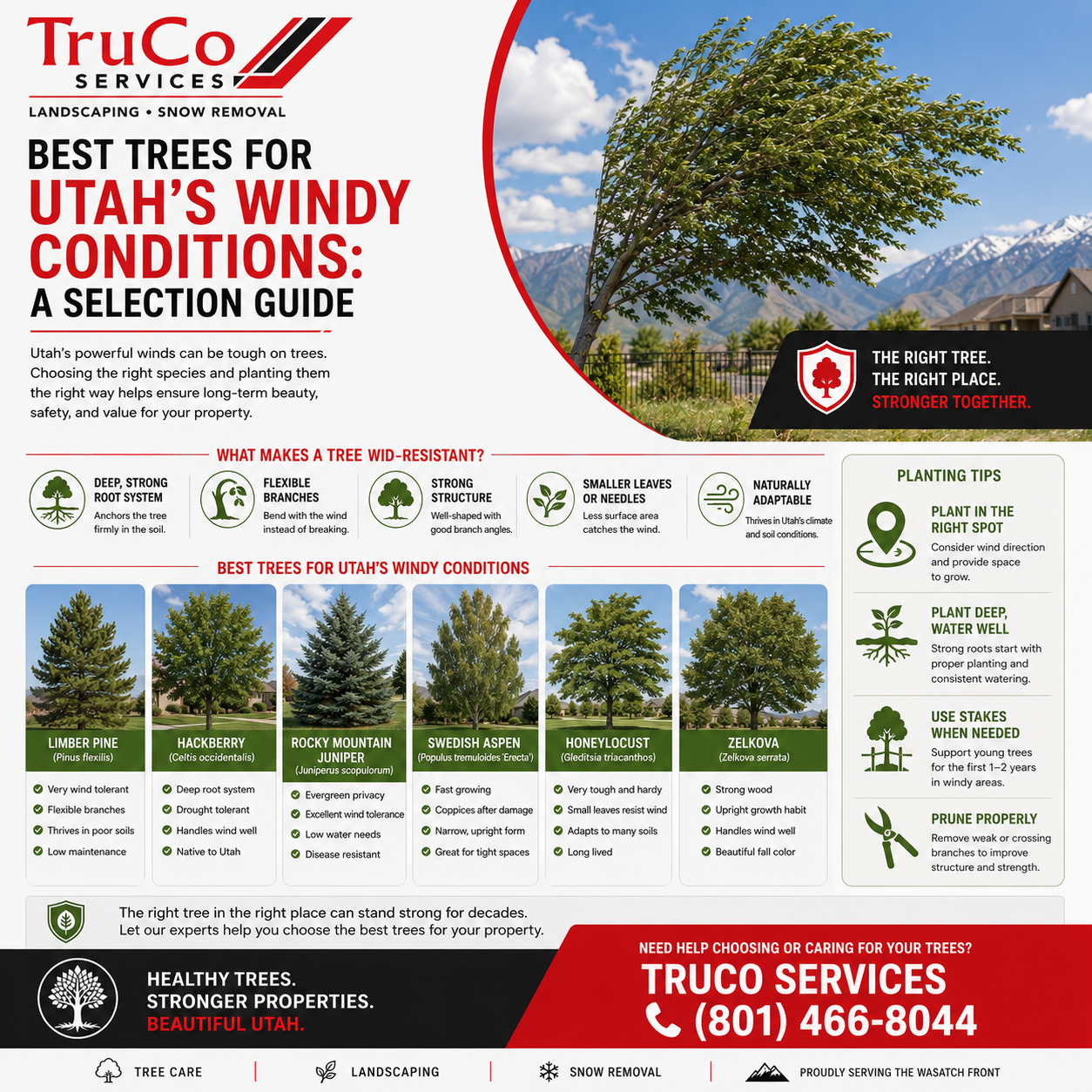
Understanding Utah's Wind Challenges for Trees
Utah experiences some of the most challenging wind conditions in the Intermountain West. From the famous canyon winds that funnel through Parley's Canyon and other Wasatch Front canyons to the seasonal gusts that sweep across the Great Basin and the sudden microbursts of summer thunderstorms, wind is a constant factor for trees in Utah. These winds can exceed 60-80 mph during storms, toppling weak-rooted trees, snapping trunks, and shredding foliage. The combination of Utah's high elevation (4,000-7,000 feet along the Wasatch Front), exposed terrain, and significant temperature differentials creates wind patterns that stress trees year-round. Winter winds desiccate evergreen foliage, spring winds can damage new growth and flowers, and summer winds from thunderstorms can cause catastrophic failure in poorly anchored trees. Choosing wind-resistant tree species is essential for any Utah landscape, particularly in exposed areas like the east bench of the Salt Lake Valley, the benches of Davis and Utah Counties, and the open spaces of Tooele Valley. This guide covers the best tree species for Utah's windy conditions and how to plant and maintain them for maximum wind resistance.
Characteristics of Wind-Resistant Trees
Wind-resistant trees share several key characteristics. Flexible wood that bends rather than breaks under wind pressure. Trees like honeylocust and Kentucky coffeetree have flexible branching that allows them to sway without breaking, while brittle species like silver maple and box elder are prone to wind breakage. Strong branch attachments — trees with wide branch angles (U-shaped rather than V-shaped crotches) are less likely to split in wind. Species like bur oak and linden naturally develop strong branch attachments. Deep, spreading root systems anchor the tree against overturning. Trees with a strong taproot plus extensive lateral roots are most resistant to windthrow. In Utah's clay soils, trees with naturally wide-spreading root systems like hackberry and Kentucky coffeetree perform well. Dense, flexible foliage allows wind to pass through the canopy rather than pushing against a solid surface. Conifers with flexible needles (like ponderosa pine) handle wind better than those with stiff, dense foliage. Smaller, tougher leaves reduce wind resistance compared to large, soft leaves. Oaks, honeylocust, and hackberry have leaf structures that minimize wind damage. Strong central leader — trees with a single dominant trunk are structurally stronger than multi-stemmed trees, which are more prone to splitting in wind. Proper trunk taper — trees that taper gradually from base to tip are more wind-resistant than trees with a narrow base relative to their height.
Top Wind-Resistant Trees for Utah
The following tree species have proven wind resistance in Utah conditions. Bur oak (Quercus macrocarpa) is one of the most wind-resistant trees for Utah. Its strong wood, deep taproot, and sturdy branch structure make it highly resistant to wind damage. Grows 60-80 feet tall with a broad crown. Adaptable to various soil types including Utah's clay. Excellent for open, exposed sites. Kentucky coffeetree (Gymnocladus dioicus) has flexible, open branching that allows wind to pass through. Deep root system provides excellent anchorage. Grows 50-70 feet tall. Tolerates urban conditions and alkaline soil. Late to leaf out in spring, which avoids wind damage to tender new growth. Honeylocust (Gleditsia triacanthos) has fine, feathery foliage that offers minimal wind resistance, flexible branches, and a strong root system. Grows 40-60 feet tall. Provides dappled shade that allows grass to grow underneath. Thornless and seedless varieties are available. Hackberry (Celtis occidentalis) tolerates Utah's alkaline clay soil and harsh conditions. Develops a deep, spreading root system. Grows 40-60 feet tall. Extremely hardy and adaptable. Provides good windbreak value. Ponderosa pine (Pinus ponderosa) develops a deep taproot with extensive lateral roots. Flexible needles reduce wind resistance. Grows 60-100 feet tall. Excellent for higher elevations in Utah. Tolerates drought and poor soils. Ginkgo (Ginkgo biloba) has strong wood and a naturally pyramidal shape that provides wind resistance. Grows 50-80 feet tall. Pest-resistant and long-lived. Male cultivars (like 'Autumn Gold') are recommended as they produce no messy fruits. Littleleaf linden (Tilia cordata) has strong wood and a dense, pyramidal crown. Grows 50-70 feet tall. Develops strong branch attachments if properly pruned. Tolerates urban conditions. Good for windbreaks and shelterbelts. Concolor fir (Abies concolor) has strong, flexible branches and a deep root system. Grows 50-70 feet tall. Tolerates Utah's alkaline soil better than other firs. Excellent for higher elevation windbreaks. Utah juniper (Juniperus osteosperma) is extremely wind-resistant due to its tough wood, flexible branches, and deep root system. Typically grows 15-30 feet tall. Native to Utah and adapted to harsh conditions. Excellent for exposed, rocky sites. Avoid brittle or weak-wooded species in windy areas: silver maple, box elder, Siberian elm, poplar hybrids, willows (in exposed locations), and Bradford pear.
Planting Trees for Wind Resistance
Proper planting technique significantly affects a tree's wind resistance. Plant at the right depth — the root flare must be at or slightly above ground level. Trees planted too deep develop circling roots and poor anchorage, making them prone to windthrow. In Utah's clay soil, planting slightly high is better than too deep. Dig a wide planting hole — 2-3 times the width of the root ball — to encourage roots to spread outward. Wide-spreading roots provide better anchorage than roots confined to a narrow hole. Avoid overwatering — deep but infrequent watering encourages deep root growth. Shallow, frequent watering produces shallow roots that are more susceptible to windthrow. In Utah, water deeply once per week during the growing season, adjusting for rainfall. Stake properly — if staking is necessary (in very windy locations), use flexible ties and remove stakes after one growing season. Studies show that unstaked trees develop stronger trunks and root systems. Use two or three stakes rather than one to allow natural movement. Provide wind protection during establishment — temporary windbreaks or tree wraps can protect young trees during their first 1-2 years. In Utah's exposed locations, a simple burlap screen or commercial tree shelter can prevent wind damage while the tree establishes. Space appropriately — wind-resistant trees need adequate space to develop strong root systems. Overcrowded trees compete for resources and develop weaker structures. Follow recommended spacing for each species.
Maintaining Wind-Resistant Trees
Ongoing maintenance keeps trees structurally sound and wind-resistant. Structural pruning — prune young trees to develop a strong central leader and well-spaced, wide-angled branches. This is the most important maintenance task for wind resistance. In Utah, structural pruning should be done in late winter or early spring before growth begins. Remove weak branches — eliminate branches with narrow (V-shaped) crotch angles, included bark, or other defects that make them prone to wind breakage. These defects are particularly common in fast-growing trees. Maintain crown balance — avoid over-pruning on one side, which creates an unbalanced crown that is more vulnerable to wind. A balanced, symmetrical crown distributes wind forces evenly. Monitor root health — watch for signs of root rot, girdling roots, or soil compaction. Healthy roots are essential for wind anchorage. In Utah's clay soil, soil compaction from foot traffic or equipment can weaken root systems for years. Remove hazardous limbs — have a certified arborist inspect large, overhanging branches annually. Remove dead, dying, or weakly attached branches before they become wind hazards. In Utah's snow country, the combination of wind and heavy snow loads can cause branch failure even in healthy trees. Maintain mulch — 2-4 inches of organic mulch over the root zone moderates soil temperature and moisture, promoting healthy root growth. Keep mulch away from the trunk to prevent rot.
Frequently Asked Questions
What is the most wind-resistant tree for Utah? Bur oak is widely considered the most wind-resistant tree for Utah conditions. Its strong wood, deep taproot, and sturdy branch structure make it exceptionally resistant to wind damage. Kentucky coffeetree and honeylocust are also excellent choices for very windy sites.
What trees should I avoid planting in windy Utah locations? Avoid brittle-wooded species like silver maple, box elder, Siberian elm, hybrid poplars, and willows in exposed locations. Also avoid multi-stemmed trees and trees with narrow crotch angles. Bradford pear (Callery pear) is notorious for wind breakage.
How can I protect a newly planted tree from wind in Utah? Use temporary windbreaks (burlap screens, tree shelters), stake properly with flexible ties, and ensure deep, infrequent watering to encourage deep root growth. Remove stakes after one year. In extremely windy locations, consider a temporary fence or windbreak fabric.
Is it better to plant wind-resistant trees in groups or alone? Group plantings provide mutual wind protection. Trees planted in clusters or rows (as in a windbreak) experience less wind stress than isolated trees. However, ensure adequate spacing to avoid competition for resources. A mix of species provides the best windbreak.
Can pruning make a tree more wind-resistant? Yes. Structural pruning to develop a strong central leader, wide branch angles, and a balanced crown significantly improves wind resistance. Removing dead, diseased, or weakly attached branches prevents them from becoming wind hazards. However, avoid over-pruning, which can make trees more vulnerable.
How do Utah's clay soils affect wind resistance? Clay soils can reduce wind resistance by limiting root depth. Tree roots in clay tend to grow wide and shallow rather than deep. This makes trees more prone to windthrow (being blown over) compared to trees in well-drained soils with deep taproots. Proper soil preparation and planting technique are critical in clay soils.