
Best Trees for Utah Front and Back Yards by Location

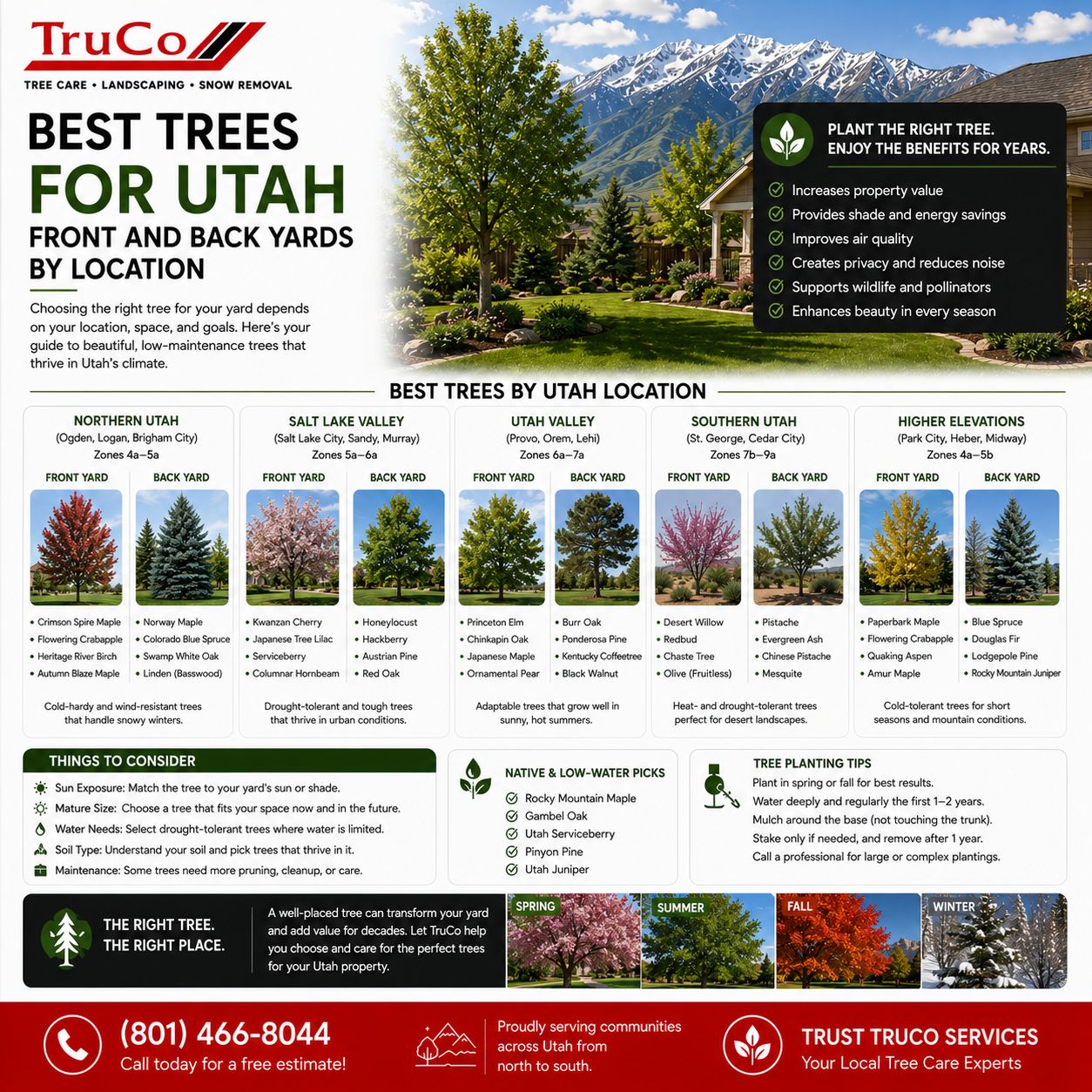
Best Trees for Utah Front and Back Yards by Location
Choosing the right tree for the right spot on your Utah property is essential for long-term success. Different locations have different needs — front yards need curb appeal, backyards need shade and privacy, and small lots need compact trees. Utah's alkaline soil, clay, and climate zones add another layer of consideration. This guide matches tree species to specific locations on your property.
Front Yard Trees for Curb Appeal
Front yard trees should enhance your home's appearance without overwhelming it. Japanese tree lilac grows 20-25 ft with creamy white June flowers and tolerates Utah's alkaline soil perfectly. Eastern redbud grows 20-30 ft with stunning pink spring flowers and moderate alkaline tolerance. Crabapple grows 15-20 ft with spring flowers, persistent winter fruit, and excellent alkaline tolerance. Amur maple grows 15-20 ft with brilliant red fall color and is very alkaline-tolerant. Serviceberry grows 15-25 ft with multi-season interest: white spring flowers, edible berries, and good fall color.
Backyard Shade Trees
Backyards need large shade trees for summer cooling. Kentucky coffeetree grows 40-50 ft with dappled shade, strong wood, and excellent drought and alkaline tolerance. Bur oak grows 60-80 ft with massive canopy, strong wood, and 200+ year lifespan — but needs plenty of space. Hackberry grows 40-60 ft with adaptability to heat, drought, and alkaline soil. Honeylocust grows 30-45 ft with dappled shade good for grass underneath and moderate tolerance.
Privacy Screening Trees
For blocking views and creating privacy, evergreens are best. Rocky Mountain juniper grows 20-30 ft, is native to Utah, and extremely drought-tolerant. Austrian pine grows 40-60 ft, tolerates alkaline soil, and provides dense year-round screening. Arborvitae grows 15-30 ft depending on variety but needs regular water. Colorado blue spruce grows 50-75 ft but is susceptible to spider mites in Utah landscapes.
Small Yard Solutions
For townhouses and small lots, choose compact trees. Japanese tree lilac (20-25 ft), Amur maple (15-20 ft), crabapple (15-20 ft), and serviceberry (15-25 ft) all fit small spaces. Avoid large species like cottonwood, silver maple, and Austrian pine — they will outgrow the space within 10-15 years.
Trees for Specific Utah Areas
Salt Lake Valley (zone 5b-6b): bur oak, Kentucky coffeetree, hackberry, Austrian pine. Utah Valley (zone 5a-6a): same species but choose cold-hardy varieties. Bench areas (zone 4b-5a): limber pine, bristlecone pine, Rocky Mountain juniper. Mountain areas (zone 4a-4b): Colorado blue spruce, subalpine fir, quaking aspen.
Trees to Avoid in Utah
Silver maple: weak wood, prone to storm damage, invasive surface roots. Cottonwood: aggressive roots seek water, break in storms. Siberian elm: invasive, weak wood, short-lived. Box elder: weak wood, attracts boxelder bugs. Weeping willow: roots invade sewer lines, branches break easily.
Frequently Asked Questions
What is the best front yard tree in Utah? Japanese tree lilac for flowers and size. Kentucky coffeetree for shade.
What is the fastest-growing shade tree for Utah? Kentucky coffeetree and hackberry both grow 2-3 ft per year once established.
What tree is best for privacy in Utah? Rocky Mountain juniper for low water. Austrian pine for dense screening.
Can I plant a tree near the house in Utah? Large trees 20+ ft away. Small trees 10-15 ft away.