
How to Amend Soil Around Existing Trees in Utah

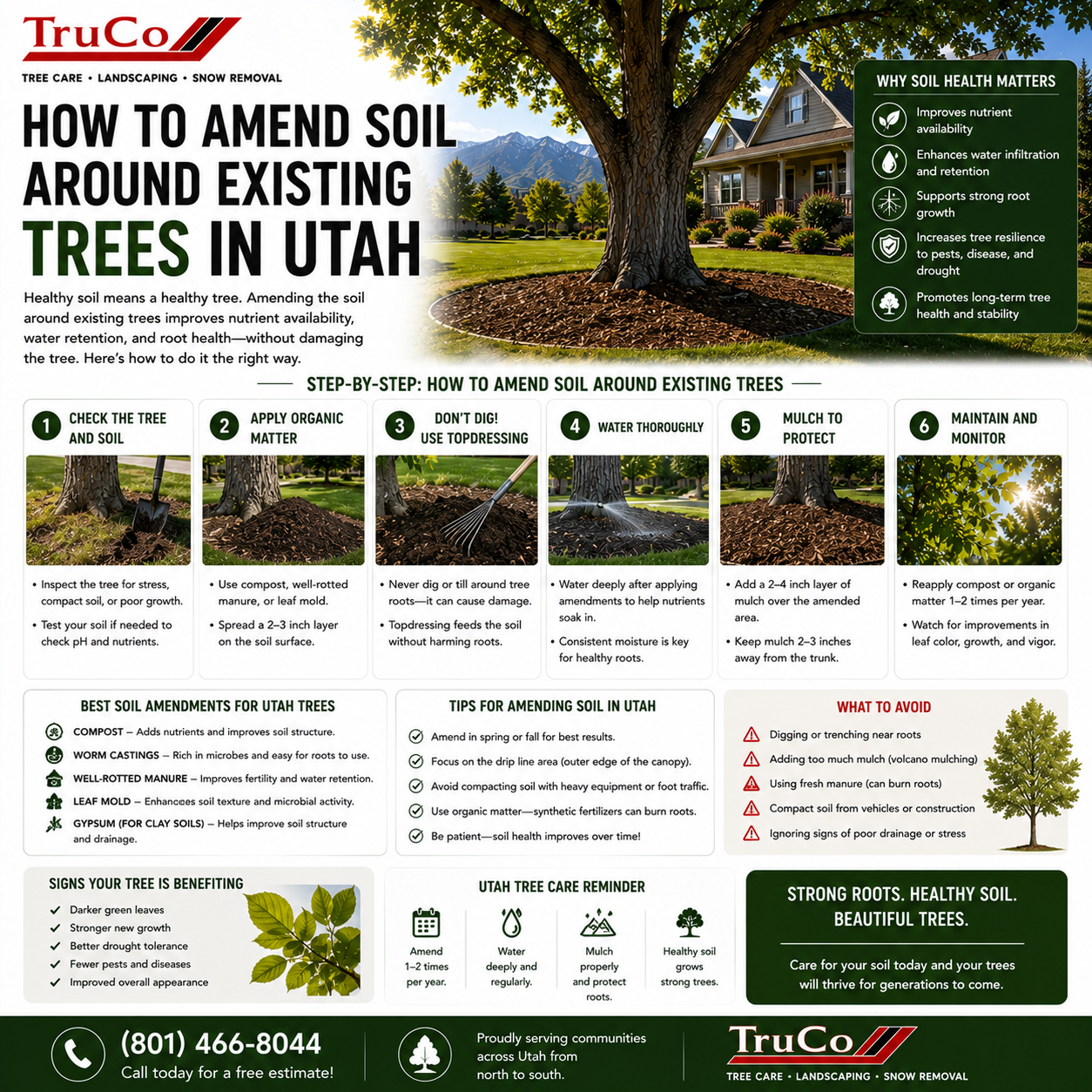
Why Amend Soil Around Existing Trees in Utah
Utah's native soil presents significant challenges for tree health. The alkaline clay soil typical along the Wasatch Front has a pH of 7.5-8.5, is low in organic matter, compacts easily, and drains poorly. While it's relatively simple to prepare soil properly when planting a new tree, amending the soil around an established tree requires a different approach. You cannot simply till or dig up the entire root zone without causing serious damage. However, improving soil conditions around existing trees is possible and often necessary. Trees growing in Utah's unimproved native soil often suffer from iron chlorosis (yellow leaves), slow growth, and increased susceptibility to pests and diseases. Soil amendment can correct nutrient deficiencies, improve water infiltration, increase oxygen availability to roots, and promote beneficial microbial activity. This guide covers safe, effective methods for improving soil around established trees in Utah without damaging their root systems.
Assessing Soil Conditions Before Amending
Before amending soil around existing trees, assess the current conditions. A soil test is essential. Utah State University Extension offers affordable soil testing through their Analytical Labs (USUAL). The test will tell you pH, organic matter content, nutrient levels, and texture. Cost is typically $20-40 per sample. In Utah, the most common soil issues affecting trees are high pH (alkaline), low organic matter (often less than 1%), compaction (especially in urban and construction-impacted soils), and specific nutrient deficiencies (iron, manganese, zinc). Observe your tree's condition for clues about soil health. Yellow leaves with green veins suggest iron chlorosis from high pH. Sparse foliage or slow growth may indicate nutrient deficiencies or compaction. Water puddling or runoff suggests poor drainage from compacted clay. Wilting despite adequate watering can indicate root zone compaction. Check soil texture by feeling a moist soil sample. Utah clay feels sticky and forms a ribbon when squeezed between your fingers. Soil with adequate organic matter feels crumbly and dark. Test drainage by digging a 12-inch deep hole, filling it with water, and timing how long it takes to drain. In Utah clay soil, drainage rates of 1-2 inches per hour are typical; anything slower indicates compaction problems.
Surface Application: The Safest Method
The safest and most effective method for amending soil around existing trees is surface application — spreading amendments on top of the soil over the tree's root zone. This method works because tree roots are concentrated in the upper 6-18 inches of soil, and surface-applied amendments gradually work their way down through earthworm activity, water infiltration, and freeze-thaw cycles. Apply organic matter (compost, aged manure, leaf mold) at a rate of 1-2 inches over the entire root zone (from a few feet from the trunk to the dripline and beyond). In Utah, well-decomposed compost from local sources works best. Avoid fresh manure or uncomposted materials that can burn roots. Apply in spring or fall when soil temperatures are moderate. In Utah, April-May and September-October are ideal. Do not pile amendments against the tree trunk — keep them 6-12 inches away from the trunk to prevent bark rot. For lawns under trees, aerate before surface application to improve amendment penetration. In Utah's clay soil, core aeration is particularly beneficial before top-dressing with compost. A thin layer (1/4-1/2 inch) of compost can be spread over lawn areas under trees each spring. Cover the amended area with 2-3 inches of wood chip mulch. The mulch holds amendments in place, moderates soil temperature, and gradually decomposes to add more organic matter. Keep mulch away from the trunk. Over multiple years, surface application of organic matter can significantly improve soil structure, water infiltration, and nutrient availability in Utah's clay soils.
Liquid Soil Amendments for Established Trees
Liquid amendments can be injected into the root zone or applied to the soil surface for faster results. Liquid iron chelates (like Fe-EDDHA) are highly effective for treating iron chlorosis in Utah's alkaline soil. Applied as a soil drench in spring, chelated iron remains available to roots even at high pH. Follow product directions carefully. In Utah, iron chlorosis treatment is one of the most common and successful soil amendment practices. Liquid humates and kelp extracts improve soil structure and stimulate root growth. They can be applied as a soil drench or through drip irrigation. In Utah's clay soil, humates help break up compacted soil particles. Apply 2-3 times per growing season. Liquid seaweed extracts provide micronutrients and growth hormones that benefit stressed trees. Apply as a foliar spray or soil drench. Particularly useful for trees showing stress symptoms. Mycorrhizal inoculants can be applied as a liquid drench to introduce beneficial fungi that form symbiotic relationships with tree roots. These fungi extend the tree's root system and improve nutrient and water uptake. In Utah's disturbed soils, beneficial mycorrhizae are often lacking. Soil surfactants (wetting agents) improve water infiltration in hydrophobic soils. In Utah, soils that have been dry for extended periods can become water-repellent. Surfactants help water penetrate evenly. Liquid amendments are most effective when applied through deep root feeding or soil injection. Professional arborists in Utah use injection equipment to deliver amendments 6-12 inches deep into the root zone. This method delivers materials directly to the root zone with minimal surface disturbance. Cost is typically $100-300 per tree depending on size and product used.
Soil Aeration Around Existing Trees
Compacted soil is one of the most common problems for trees in Utah's urban landscapes. Soil aeration improves oxygen exchange, water infiltration, and root growth in compacted soils. Core aeration removes small plugs of soil from the root zone, creating channels for air, water, and roots. For trees in lawn areas, core aeration in spring or fall is beneficial. In Utah, aerate when soil is moist but not wet — typically April or September. Avoid aerating within the root zone of shallow-rooted trees like maples and birches, where aeration equipment can damage surface roots. Vertical mulching is a more intensive aeration technique. Holes 2-4 inches in diameter and 12-18 inches deep are drilled or augered in a grid pattern throughout the root zone. The holes are filled with compost, perlite, sand, or a mixture of these materials. This creates channels for root growth and improves soil structure. In Utah, vertical mulching is particularly effective in compacted clay soils common in new developments. Air spading uses compressed air to break up compacted soil without damaging roots. A certified arborist uses an air spade tool to inject high-velocity air into the soil, fracturing compacted layers. This is the most effective method for treating severe soil compaction around established trees. In Utah, air spading costs $75-150 per hour and is recommended for trees showing significant compaction stress. After any aeration treatment, apply organic matter and water deeply to help the soil recover. In Utah's clay soil, aeration plus organic matter application is a powerful combination for improving tree health.
Correcting Nutrient Deficiencies in Utah Trees
Nutrient deficiencies are common in Utah's alkaline soil. The most effective correction methods depend on the specific deficiency. Iron deficiency (chlorosis) is the most common problem in Utah. Yellow leaves with green veins, most visible on new growth. Treatment: soil application of iron chelates (Fe-EDDHA) in spring, or trunk injection by a certified arborist for severe cases. In Utah, silver maple, red maple, pin oak, and aspen are most susceptible. Manganese deficiency causes interveinal chlorosis on younger leaves, similar to iron deficiency but with different patterns. Treatment: soil application of manganese sulfate or foliar sprays. Common in Utah on oaks and maples. Zinc deficiency causes stunted, rosetted leaves and reduced shoot growth. Treatment: soil application of zinc sulfate or foliar zinc sprays. Common in Utah on fruit trees and some ornamentals. Nitrogen deficiency causes overall yellowing (pale green to yellow leaves) and reduced growth, most visible on older leaves first. Treatment: surface application of slow-release organic nitrogen sources like compost, blood meal, or feather meal. Avoid high-nitrogen synthetic fertilizers that can burn roots in Utah's dry soil. Phosphorus deficiency is rare in Utah soils but can occur in highly alkaline conditions. Treatment: bone meal or rock phosphate applied to the soil surface. Not usually needed for established trees. For all deficiencies, a soil test is the first step. Applying the wrong amendment can make problems worse. In Utah, many homeowners apply iron to trees that actually have manganese deficiency, wasting money and not solving the problem. Work with a certified arborist or USU Extension for accurate diagnosis and treatment recommendations.
Frequently Asked Questions
Can I dig compost into the soil around an existing tree? Avoid digging or tilling within the root zone of established trees. Surface application of compost is safer and equally effective. Digging severs tree roots, damages the root system, and can destabilize the tree. Let earthworms and water carry the compost down naturally.
How often should I amend soil around trees in Utah? Apply organic matter (compost) once or twice per year — in spring and fall. Liquid amendments can be applied 2-3 times per growing season as needed. Soil tests every 2-3 years help guide amendment choices. Over-amending can be as harmful as under-amending.
What is the best compost for Utah trees? Well-decomposed organic compost from local sources that has been properly composted (reaches high temperatures during processing) is best. Avoid fresh manure or uncomposted materials. Utah GreenWaste compost and municipal compost programs produce excellent products for tree care.
How long does it take to see results from soil amendment in Utah? Surface-applied organic matter shows results within 1-2 growing seasons. Liquid iron chelates can show results (greener leaves) within 2-4 weeks. Vertical mulching and air spading show results within one growing season. Patience is important — soil improvement is gradual.
Do I need to adjust soil pH for trees in Utah? Lowering pH in Utah's alkaline soil is difficult and temporary. It's usually more practical to choose trees adapted to alkaline conditions than to fight the natural soil pH. For existing trees, use iron chelates and organic matter to manage pH-related deficiencies rather than trying to change the pH.
Should I fertilize or amend the soil first? Amend the soil first. Improving soil structure and organic matter content creates conditions where roots can efficiently absorb nutrients. Fertilizing compacted, low-organic-matter soil is like putting gas in a car with a clogged fuel line — the fuel won't reach the engine.